

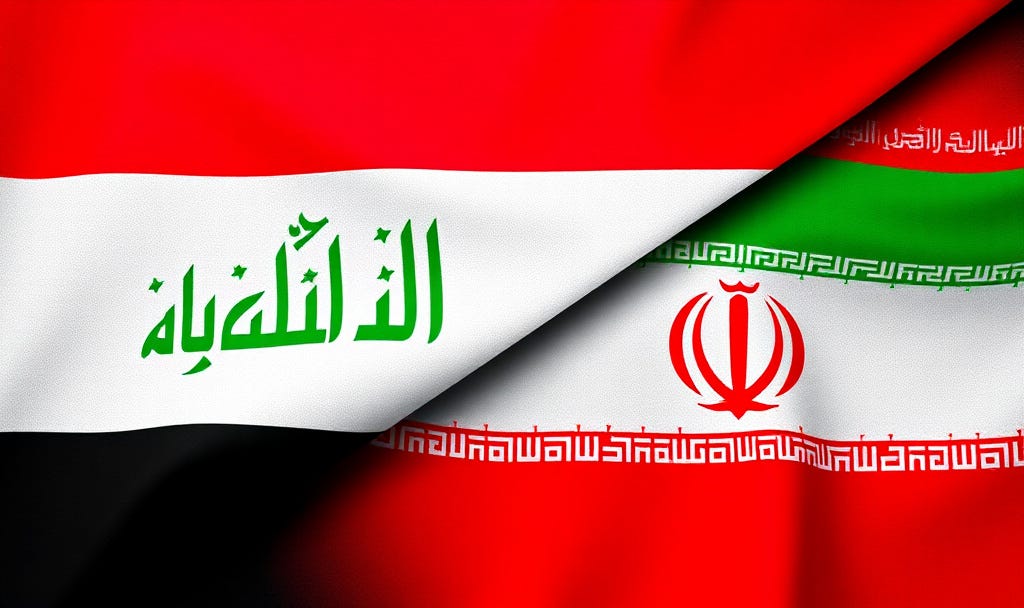
For decades, the Strait of Hormuz stood as the maritime pillar of American power in the Middle East, with Washington seen as the primary guarantor of economic security for global trade. However, the recent Iranian military and economic response to the American-Israeli-led attack on its soil has fundamentally shattered this role, as Washington can no longer secure the maritime architecture it once claimed to command.
Yet, while the world remains fixed on the fallout within the Persian Gulf, a more permanent collapse of American authority is unfolding across Iraq. One where Washington’s ability to influence internal sociopolitical and economic dynamics is being replaced by the very actors the U.S. needed to sustain its presence in the nation. This is nowhere more apparent than in Baghdad’s Green Zone, where the U.S. presence has been reduced to a localized and increasingly isolated retreat.
To understand how this collapse was engineered, one must look at the financial infrastructure that once tethered Iraq to Washington. For years, the Iraqi state was forced to circulate its oil wealth through U.S.-monitored correspondent banking channels. The system acted as a financial cage, turning Iraq into a mere administrative arm of the U.S. Treasury and granting Washington the power to track, sanction, or freeze the nation’s revenues at will.
This leverage turned the Iraqi state into a mere administrative arm of the U.S. Treasury, effectively trapping it within a financial cage. It also became an intense source of friction between Iraq and Washington as Baghdad’s political elite increasingly chafed under the oversight and began to search for measures that would bypass the system entirely.
The result was the creation of what is now known as the ‘Black Box,’ a sovereign digital framework that would replace the U.S.-managed architecture with a closed, internal settlement grid. Thus, by shifting national capital flows onto this independent, closed-looped ledger, specifically m-Bridge, Baghdad effectively decoupled its economic sovereignty from the dollar-based surveillance system that once enforced its dependency.
This mechanism was simple yet revolutionary. While the U.S. continued to monitor the nominal price of assets in dollars, the actual movement of value occurred in a parallel, private ledger. By the time Washington attempted to track the funds, the settlement had already been finalized. As a result, the U.S. was left holding only the symbol of power, while the actual movement of capital had transitioned into a closed system that answered only to Baghdad.
This shift, in turn, rendered the existing network of officials and fixers, those who had long operated as conduit for American interests, largely obsolete. As Baghdad continued to consolidate its control over this economic grid, it systematically began to dismantle the very infrastructure Washington needed to maintain its power in Iraq.
For the United States, this was not merely economic loss; it was the total collapse of its political and military leverage. By cutting Washington out of the ledger, Baghdad didn’t just reclaim its money; it opened the door for fundamental realignment. That realignment, in turn, cleared the path for Iran, Washington’s arch-rival, and its regional partners to effectively end America’s ability to dictate the political, economic, and military security of Iraq.
The reality of this new alignment became undeniable as the internal dynamics of the Iraqi state transformed. This was perhaps nowhere more apparent than in the sudden shift regarding the Kurdish region, which had long served as the primary anchor for U.S. influence. By tying all regional budget disbursements to the new centralized digital ledger, Baghdad gained the ability to monitor and restrict the flow of funds in real-time. By neutralizing the region’s independent alignment, Baghdad forced fiscal compliance on the Kurdish region that Washington could no longer easily counter or bypass.
This was not to say that Washington no longer exercised influence within the halls of power, particularly given its persistent military footprint in the Kurdish region. Nonetheless, this financial shift fundamentally weakened Washington’s grip on the political and security sector in Iraq.
Under the leadership of Hamid al-Shatri, the Iraqi National Intelligence Service (INIS) Director, for example, Baghdad began an aggressive decoupling operation, moving away from acting as an extension of U.S. intelligence and toward a model of sovereign autonomy. The recalibration of the state’s security posture became evident during the recent internal corruption purge led by Hamid al-Shatri. Through ‘Operation Dawn Strikes,’ the Iraqi security apparatus targeted corruption networks previously considered untouchable. By detaining numerous figures within the Green Zone who had long operated under the U.S.-backed frameworks, al-Shatri signaled that the old order had been discarded and was now obsolete.
Furthermore, by issuing mandates requiring all factions, including those previously labeled illegitimate by Washington, to surrender their weapons to state control, Baghdad effectively transformed these groups into formal elements of the Iraqi security apparatus. Thereby, denying the United States the ability to act against these factions as ‘independent militias.’ Also, by absorbing them into the state, Baghdad ensured that its national security priorities, rather than American demand, dictated the country’s internal order.
For the United States and the region as a whole, this shift, from a security apparatus that functioned as an extension of American oversight to one of sovereign autonomy, became the practical proof that the American era in Iraq had been dismantled.
Ultimately, this new reality was reaffirmed by the decision to hold state funeral processions for the late Supreme Leader through the holy cities of Najaf and Karbala. By placing these ceremonies within the sacred geography that has defined Shiite political authority for more than a millennium, Baghdad sent a massive political and theological message: a permanent realignment and total integration of the two states.
It also reconfirmed that Iraq has transitioned from a U.S.-led client into a cornerstone of a new, sovereign-led order. One where the authority to dictate the future of Iraq no longer originates in Washington, but within a regional gravity that has decisively moved on.
Iraq seems to go through a period of rapid socio-economic changes under its current PM, Ali Falih al-Zaidi - https://www.iraqinews.com/iraq/iraq-pm-zaidi-provincial-coordination-housing-decrees-2026/ meanwhile it is not clear if the flow of Iraqi oil revenues seems to be 'guarded' and 'protected' by the US' Federal Reserve, rather than 'controlled' or 'appropriated': "...Trump's renewal in May 2026 of the national emergency on Iraq [...] reopened a recurring dispute: whether the United States holds Iraqi oil money, or merely guards it. A fresh parliamentary inquiry into the oil ministry, demanding answers on a reported export deal with Washington, has pushed that dispute back into public view..." - https://www.shafaq.com/en/Report/Iraq-s-oil-revenues-under-US-financial-guard-23-years-after-invasion
Very interesting article and great analysis. I appreciate your insight very much. Thank you