

A month ago, I wrote an article titled “The Hollow Crown,” warning about the crisis taking over Jordan. I cautioned then that the system, which had ensured the Hashemite monarchy for decades, the sacred contract between the Palace and the tribes, was in danger of collapsing.
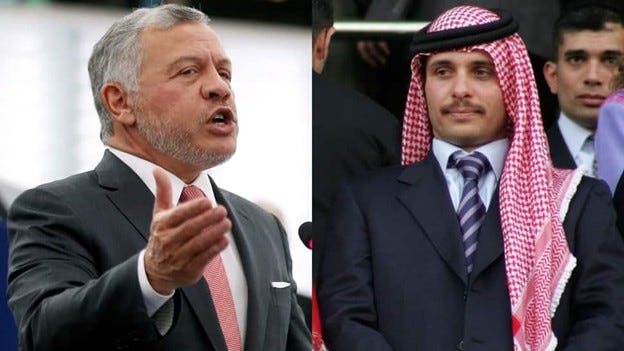
That collapse was made official today when the unified tribal councils delivered a formal letter to King Abdullah. Backed by the four major tribal powers of the nation, the Bani Hassan, Bani Sakher, Howeitat, and Bani Ahmad, the letter stated that the King’s mandate had expired and demanded that he step aside for his half-brother, Prince Hamzah.
For the tribal council, the decision to install a new King and alter a system that has defined Jordan for more than a decade wasn’t just about Prince Hamza’s physical resemblance to his father or his understanding of the tribal structure. Nor was it about King Abdullah’s “globalized” family lifestyle. Rather, it was about the King’s decision to walk away from his people, his land, and the social contract that tied the two together.
For the tribes, the monarchy was built on a simple yet direct transaction: the tribes provided absolute loyalty while the King provided security and respected the sanctity of the land. However, when the Palace began to prioritize foreign military interests over the safety of the people and the land by allowing American military bases in Jordan, that arrangement was shattered.
This betrayal left the king in a powerless position because in Jordan, the entity that provides the state’s security, the military, is made up of the same tribes that are now questioning the King. To understand why this has become so fatal to the Palace, one must look at how the nation’s armed forces are actually structured.
In Jordan, the military power is effectively split into two distinctive worlds. One is the Special Royal Guard, an elite force of 25,000 traditionally drawn from non-Arab minorities like the Circassians to ensure loyalty to the throne. The other is the Jordan Arab Army, the regular force of 115,000 soldiers who are the sons of the very tribes demanding the King’s removal.
Therefore, when the tribal councils demand a King’s exit, they are not making a political declaration. They are also sending military ones by giving their sons, nephews, and brothers a stand-down order. These tribal soldiers will not ignore their bloodline and tribal leaders for a King who broke the social contract.
For the King, on the other hand, these calls would mean the end of his reign, and that appears to be exactly what is happening to King Abdullah. The King finds himself not only largely isolated, but his Royal Guards outnumbered four to one.
This is most visible at the home of Prince Hamza in Dabouq, where the men standing watch outside are no longer Palace guards, but unified guards from the Bani Sakher and the Bani Ahmad. By surrounding the son of Queen Noor and delivering this ultimatum to the King, these tribes have shown that the “Son of Hussein” is now under the protection of the soil.
They have isolated the Palace and proved that no foreign policy can save a leadership that has been rejected by its own people. The shift I warned about a month ago is here. The system as we know it has collapsed, and with it, the Western-led policies that have defined this nation for decades.
Jordan is long overdue for a change in leadership. Let’s hope this leads to new leaders who are not servile cowards willing to prostrate themselves to the Zionists.
fascinating, thank you.