

If part 1 was about the math of the front lines, part 2 is about how Israel transitioned from a global hub to a “geopolitical island” and inadvertently ushered in a new Global Asiatic Order.
For decades, the State of Israel operated on a foundational premise: it could serve as an ultimate high-tech bridge between the West and the East. The strategy was to remain Washington’s primary military ally while simultaneously becoming Beijing’s most trusted gateway to the Mediterranean. By February 5, 2026, that bridge had not only burned but also been dismantled by the very powers that had helped build it.
While the world remained fixated on the physical hardware of the war, missiles and aircraft carriers, a far more devastating extraction was taking place in the boardrooms of Beijing and the servers of Moscow. By systematically delisting Israel from the global supply chain, Israel marked the official birth of a new Asiatic Order that no longer viewed Jerusalem as a necessary node. This was not a diplomatic chill but a permanent recalibration of the world’s economic map.
The extraction began with a classification that turned Israel’s greatest infrastructure assets into its greatest liability. In February 2026, China officially labeled Israel a “Red Zone” (High Risk) area. This was not a travel warning; it was a weaponized investment ban that triggered a massive flight of capital.
The crown jewel of this extraction lies in the Haifa Bay Port. It was here that China would demonstrate why 21st-century software is a more potent weapon than hardware.
Under intense pressure from the Trump administration’s “America First” policy to purge Chinese influence from sensitive structures, Israel attempted to decouple from Beijing. But Beijing did not wait to be pushed; it chose to walk away. By doing so, it intentionally exposed the “Haifa Trap.”
The port was designed, built, and automated by the Shanghai International Port Group (SIPG) as a proprietary “Smart Port.” Its facility cranes, electrical grids, and logistical communications are run by a Chinese automated operating system that serves as the facility’s backbone.
Because this system is proprietary, it requires active maintenance, software patches, and synchronization with Beijing’s logistical supercomputers. When China exited, it left the hardware, but took the digital key needed to run the hardware. As a result, Israel is now left with an expensive, high-grade port that can only operate with the permission of Beijing.
China’s decision to punish Israel was rooted in perceived betrayals in Taiwan and Ukraine.
For Beijing, its strategic patience reached its breaking point in late 2025 when intelligence confirmed that Israel had provided “technical learning” and ELTA radar technology to help Taiwan develop its “T-Dome” missile shield. To China, this was a direct betrayal of their cooperation. Worse, from China’s perspective, Israel was using Chinese infrastructure at home while helping to arm China’s greatest rival.
For Moscow, the shift from “neutral friend” to vocal adversary followed a similar pattern. When Israel allowed the transfer of Patriot interceptors to Ukraine (via the U.S.), it shattered the quiet “deconfliction” agreement in Syria. Putin concluded that Israel would always prioritize Western military objectives over Russian security interests, leading to a permanent “cold shoulder” from the Kremlin.
While Israel is being “extracted” from the East, Iran is being “integrated.” Tehran has successfully transitioned from a pariah state in the Western world to the critical regional hub of the China-Russia network.
In stark contrast to Israel’s shifting alliances, Iran pursued a deliberate “Reliable Partner” strategy defined by its steadfast refusal to arm the adversaries of its key allies, Russia and China. Throughout the Ukrainian conflict, Iran consistently supplied Moscow with advanced drone and missile technology, reinforcing its role as a dependable collaborator in the China-Russia-Iran axis.
This unwavering loyalty has earned Iran a “winner” status within the new regional order. In exchange for the “Red Zone” classification of Israel, Iran has guaranteed China a steady supply of discounted oil. Thereby, securing Beijing’s energy needs while ensuring Tehran’s own economic survival.
The relationship has created a closed-loop economy that directly rewards Iran’s consistency and reliability, while simultaneously punishing Israel for its “double-dealing” and lack of allegiance.
Hence, as Israel fractures, its main adversary, Iran, becomes one of the trios that will define the new power structure in the system. The trilateral pact between China, Iran, and Russia ( C.I.R. Alliance) has formed a “Sanction-Proof” strategic bloc marked by a clear and deliberate division of labor designed for the 21st-century geopolitical world.
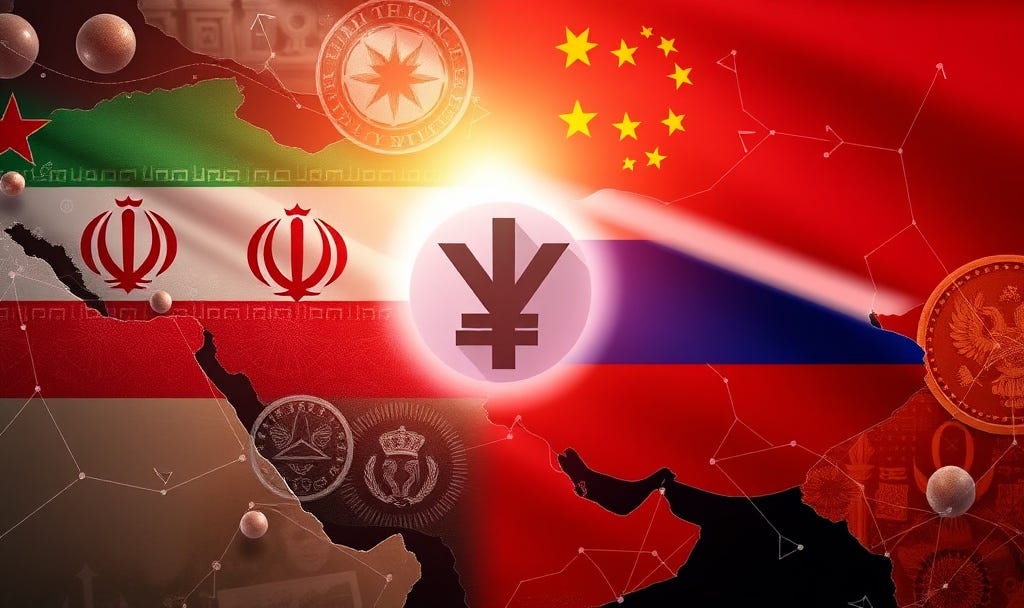
China will serve as the financial engine of the alliance by providing the capital and the Digital Yuan settlement systems needed to bypass the dollar. Russia provides strategic security through the use of advanced electronic warfare (EW) technology and offers political defense “cover” at the United Nations. Iran, because of its geographic location and military capabilities, provides the regional boots on the ground and the energy security needed to maintain stability and power.
For Israel and its allies, this bloc is no longer fighting the West; it is simply out-building and out-moving it. By trading in Yuan and Rubles, they have neutralized the U.S. “financial hammer,” thus destroying the ability of the U.S. and Israel to sanction Iran into oblivion.
Furthermore, Israel now finds itself squeezed between an East that says, “we don’t need you,” and a West that says, “we cannot afford you.”
By trying to outmaneuver the East with tech transfers, Israel gave the Asiatic Global Order the perfect excuse to walk away. Jerusalem now faces the risk of becoming a “geopolitical island”: a U.S. protectorate that is increasingly expensive to maintain and isolated from the new trade routes of the 21st-century.
The Asiatic Global Order is the primary beneficiary of this change, and as C.I.R. Alliance consolidate their hold on the Levant, the focus now shifts Eastward to the next great land bridge.
Stay tuned for the continuation of this series, where we break down how the “Asiatic Global Order” is out-building and out-moving the West across the heart of the Middle East. In Part 3, we will discuss Iraq and its role in the reshaping of the Central Corridor.
Subscribe to my Substack to ensure you don’t miss Part 3.
I’ve been reading through this series and your other writings and find them consistently thought-provoking. This piece, in particular, sharpens a number of real dynamics—but I think it overstates the mechanism in a few key places.
This is a tightly written piece—but it reads more like narrative construction than reporting. It blends real elements (ports, alliances, tensions) with unverified leaps to produce a coherent “system shift” story. Here’s a grounded read.
What’s real enough to anchor the story
• Shanghai International Port Group (SIPG) operates Haifa’s Bayport terminal under a long-term concession.
• China uses risk controls on outbound investment; activity in conflict zones can slow or pause.
• Israel balances ties between the U.S. and China—under pressure from Washington on sensitive infrastructure.
• Iran–Russia cooperation (e.g., drones) and China’s energy ties with Iran are real.
These give the article a credible surface.
Where it departs from evidence
1) “China officially labeled Israel a Red Zone”
• No clear public, formal designation covering all of Israel.
• Claims trace back to secondary reporting/legal filings, not an official decree.
• Scope likely partial/conditional, not a blanket, permanent ban.
2) “Systematic delisting from the global supply chain”
• There’s no mechanism for “delisting a country” from global supply chains.
• Israel remains deeply integrated in tech, defense, and trade networks.
3) The “Haifa Trap” (digital kill-switch control)
• Modern ports use proprietary software, yes—but:
• Systems are installed and run locally
• No credible evidence of a remote ‘Beijing key’ required to operate
• Critical infrastructure contracts include continuity and override provisions
• Real risk = vendor dependence and maintenance friction, not on/off control.
4) “Complete withdrawal” and “dismantling infrastructure”
• No credible reporting of full Chinese personnel evacuation.
• Ports and tunnels don’t stop working because foreign engineers leave.
5) Specific triggers (Taiwan radar, Patriots to Ukraine)
• Presented as decisive causes without verifiable sourcing.
• Even if tensions exist, the direct causal chain is asserted, not shown.
6) The “C.I.R. Alliance” as a formal, coordinated bloc
• China, Russia, and Iran cooperate—but:
• Not a formal, unified command bloc with a clean division of labor
• China is cautious, often avoiding deep entanglement in volatile theaters
7) “Sanction-proof” system / dollar bypass
• Yuan/ruble trade exists, but:
• The dollar system still dominates globally
• Sanctions are less effective in some channels, not neutralized
What the article is really doing (structure)
• Anchor in reality (ports, SIPG, geopolitics)
• Introduce a sharp concept (“Red Zone,” “Haifa Trap”)
• Escalate to totalizing claims (full extraction, permanent recalibration)
• Install a new order (C.I.R. bloc, “Asiatic Global Order”)
It’s internally consistent—but light on independently verifiable specifics.
A more grounded version of the situation
• China likely reduces exposure in higher-risk areas and is selective with new capital.
• Israel faces balancing pressure between U.S. security concerns and Chinese investment.
• Chinese-built infrastructure can create dependency costs (maintenance, upgrades, vendor lock-in).
• Regional alignments are shifting, but not into a clean, sanction-proof bloc.
Bottom line
This is a coherent geopolitical narrative, not a substantiated operational account.
• Real trend: cautious capital, supply-chain adjustments, strategic hedging
• Not supported: total “extraction,” remote control of infrastructure, formalized trilateral command system
The direction of travel may be right—but the mechanism matters. Without that distinction, it’s easy to mistake a gradual realignment for a decisive break.
I find it interesting that you have completely left out the surge of Europe especially after the Munich conference . Because you are fixated on a new order (which I call the new disorder), you simplify matters by assuming partnerships and alliances work in this part of the world (and we have witnessed that they do not).
You also generalize many statements which I believe you’ve borrowed or copied from other authors to make your point .
If you truly believe that Iran is the new power house , that China is doing hunky dory and that Russia isn’t completely being wiped out by the loss of human life, then I have property to sell you in the fields of Rangoon