

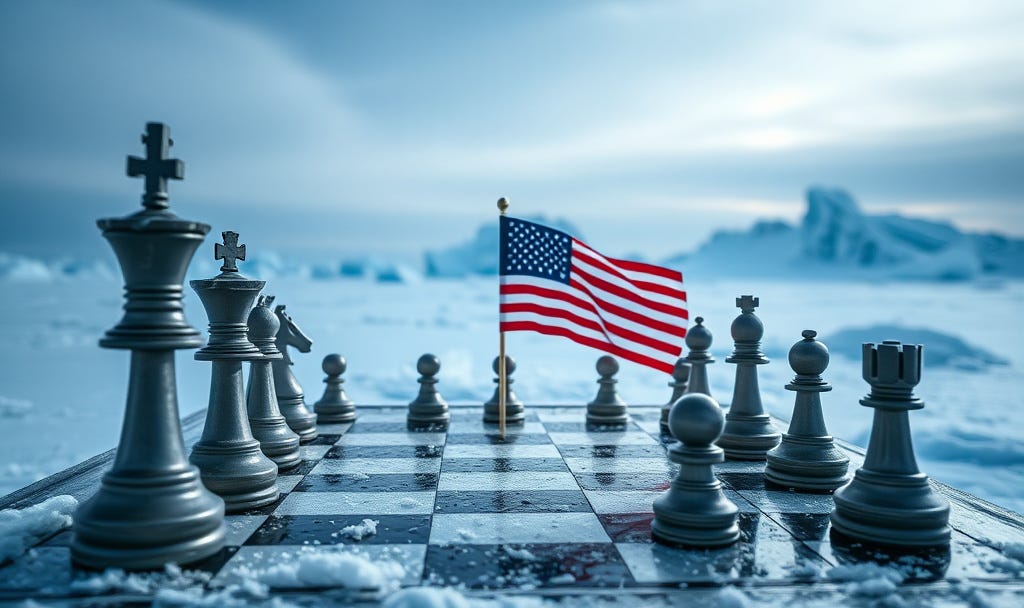
“As the U.S. leverages raw interest against its oldest allies in Greenland, the ‘rules-based order’ is replaced by a universal standard or power, signaling the dawn of a new Global Asiatic order.”
The unfolding crisis in Greenland has become a flashpoint not only for Western security but also a testimony to Western double standards and prejudice.
For the Global South, the swift and indignant response from European NATO allies to President Trump’s demands for acquiring Greenland has been met with irony and cynicism. For nations in Latin America, the Middle East, Africa, and Asia, the sight of European powers deploying troops to defend a “Eurocentric” Western neighbor is based more on geography and geology than any universal moral compulsion.
For the non-Eurocentric world, this double standard is nowhere more visible than in the recent U.S. intervention in Venezuela. On January 3, 2026, the Trump administration’s pressure led to the military removal of its President, Nicolas Maduro. The act, though against international law, was met with a deafening silence from Europe; however, when Denmark appeared to be threatened by the US, Europe responded with military deployments and the threat of economic retaliation.
This inconsistency didn’t go unnoticed, particularly in the Islamic world, where commentators from Cairo to Jakarta pointed out that Western powers’ defense of human rights is often based on their faith and geography rather than actual principles.
At the same time, for the first time, the President is signaling to the world that there is no longer a difference between the “Islamic world” and “Europe” when it comes to American interests.
Addressing the Danish refusal to sell, President Trump remarked that “we are going to do something on Greenland whether they like it or not,” and followed through by announcing a 10 percent tariff on eight European allies, including France and the UK, for their “interference” in the territory.
By dismissing European objections and referring to Greenland’s security as nothing but a “two-dog sleds,” the administration has made it clear that the “might-makes-right” policy once reserved for nations like Iraq, Venezuela, or Libya is now going to be used against American allies.
For non-Western nations, the shift in American philosophy towards its own European allies further proves the need for a new Asian led global order. Leaders in the BRICS+ blocs, like China and Russia, are using the crisis to argue that Western-led institutions like NATO can no longer be stable guarantors of security since even a founding NATO member like Denmark is no longer safe. For them, a new, multipolar world is needed where the defense of human rights and territorial integrity is not just reserved for those from certain geographic and socio-cultural borders.
At the end, the Greenland standoff is not just about natural resources and security concerns. Rather, the test of whether “rules-based order’ applies to everyone, or only to those who share the same history, region, and ethnicity as the powers that wrote them. Regardless of what happens, the calls for a new global order remain, and 2026 will perhaps be the year that the calls will be answered.