

This is the final instalment in our 6-part series mapping the strategic restructuring of the Middle East. We have moved from the internal collapse of the Western influence in the U.S. and Israel, through the “Back Door” architectures of Iraq and Syria, to the Mediterranean Terminus in Lebanon. Today, we witness the completion of the C.I.R.’s grand design.
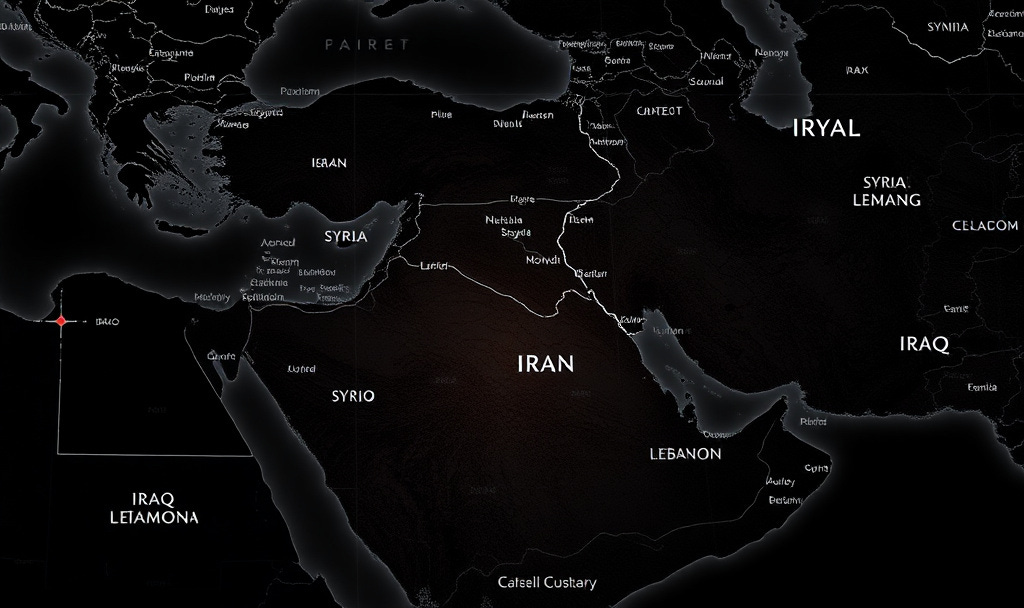
The cycle is complete. What began as a localized friction in Israel has expanded into a regional transformation that the West no longer controls. As of today, March 2, 2026, the world is watching a historical pivot. Despite the massive U.S. and Israeli bombardment of Tehran under Operation Epic Fury, Iran has officially rejected all ceasefire requests.
This is not a sign of desperation; it is a sign of command. The C.I.R. Alliance (China, Iran, Russia) has successfully activated the “Back Door” architecture we have tracked through Iraq, Syria, and Lebanon. The “Word of Attrition” has been spoken, and today, it is being defended by fire.
To understand the “No” coming from Tehran today, we must look at the four pillars of the alliance we have documented over this series.
Israel and Lebanon are considered the front line in the current conflict. What started in Israel has evolved into a unified northern front. Today, Hezbollah has officially joined the conflict by launching barrages at Haifa. The Chtaura Hub in Lebanon, which we identified as the Mediterranean terminal for the Alliance, has transformed from a mere digital node into the logistics center of a war that has turned the Levant into a “No-Go Zone” for Western diplomacy.
There is also Iraq, the so-called Battery of the operation. While the political “Front Door” in the Green Zone is paralyzed, the “Back Door” is wide open. Hamid al-Shatri, the intelligence chief we’ve followed, remains the ghost architect of Iraq’s survival. By moving the state’s wealth onto the mBridge platform, designed by China, Shatri ensured that the region’s economy could breathe even if the U.S. Dollar was “evicted.”
Then there is Syria, which provided the proof of concept for the Asiatic Shield. By embedding technical experts and creating “Power Islands,” the Alliance made the region’s infrastructure untouchable. Today, as the U.S. faces a “Winchester” scenario, running out of expensive interceptor missiles to stop cheap drones, the resilience of the Syrian grid proves that you cannot bomb a decentralized state.
Finally, there is the Ledger, the integrated architecture that allows Iran to ignore Washington’s calls for a ceasefire. The Alliance has successfully enforced a new regional reality.
Today, the West is fighting a 20th-century war of targets. The Alliance, on the other hand, is winning the 21st-century war of architecture. The consequences have both military and economic implications.
Militarily, over the last 48 hours, four U.S. service members have been killed in Kuwait, half a dozen or so injured, and three USAF F-15E jets crashed in a “friendly fire” disaster. The strikes have also spread across Jordan, Saudi Arabia, and the UAE, proving that the U.S. is no longer a “protector” but a target.
Economically, with the Strait of Hormuz effectively closed, Brent crude surging to $82 a barrel, insurance rates increasing by at a minimum of 50%, and COSCO stopping all of its ships going to the region, the economic impact will be extremely severe for the U.S. and the world.
From the digital wallets of Baghdad to the power grids of Damascus, the “Word of Attrition” has done its work. The U.S. may have had the military hardware, but the C.I.R. Alliance has the Ledger, the Oil, the power, and the Future. The Levant has been signed over, and the “Front Door” is officially locked.
## **When a Model Becomes a Map**
On the “Asiatic Global Order” Narrative
After working through a recent six-part series describing the emergence of an “Asiatic Global Order,” I found myself less interested in the individual claims—and more interested in the structure of the argument itself.
Because what’s being presented is not just analysis.
It’s a model.
---
### **The Appeal of a Coherent System**
The modern geopolitical landscape—especially in the Middle East—is fragmented, layered, and often contradictory:
* overlapping alliances
* competing state and non-state actors
* partial alignments that shift over time
It’s difficult to hold in a single frame.
So when a narrative appears that says:
> *this is not chaos—it’s a system*
…it has immediate appeal.
It reduces complexity.
It imposes structure.
It makes the situation legible.
---
### **From Observation to Integration**
The series builds its case using real components:
* infrastructure projects
* financial experiments
* regional alignments
* sanctions pressure
Individually, these are valid observations.
But the move that follows is more ambitious:
They are **integrated into a unified architecture**.
Iraq becomes the “battery.”
Syria becomes the “grid.”
Lebanon becomes the “terminus.”
And together, they form a coherent system—coordinated, operational, and already in place.
---
### **The Critical Shift**
This is where the model becomes something else.
Not just a way of understanding events—but a claim about reality:
> that these elements are not just related, but centrally coordinated
> not just emerging, but already complete
That shift is rarely demonstrated directly.
It is implied.
---
### **What Gets Lost**
When a model becomes a map, a few things tend to disappear:
* **fragmentation** becomes coordination
* **overlap** becomes design
* **parallel efforts** become unified strategy
And most importantly:
* **uncertainty** becomes certainty
The system starts to look cleaner than the reality it’s describing.
---
### **Direction vs. Completion**
There is a real signal underneath all of this:
* the growing importance of infrastructure
* the role of financial rails
* the emergence of parallel systems outside Western control
These trends are worth paying attention to.
But there’s a difference between:
> a direction of travel
and
> a completed system
The series consistently collapses that distinction.
---
### **Why This Matters**
If you mistake a model for a map, two things happen:
1. You overestimate the level of coordination and control
2. You underestimate the degree of instability and contestation
In other words:
You start seeing a finished structure where there is still an evolving landscape.
---
### **A More Grounded View**
A more defensible framing might look like this:
* Multiple actors are building **partial alternatives** to Western systems
* These efforts sometimes align, sometimes conflict
* Integration is **uneven, incomplete, and contingent**
That’s not a new order.
It’s a transition.
---
### **Final Thought**
There’s value in trying to see the larger pattern.
But the discipline is in knowing when the pattern is:
> something that is forming
versus
> something that has already formed
The difference is not academic.
It’s the difference between analysis—and projection.