

As the war with Iran grinds down into its sixth month, the United States finds itself sinking into a deep and inescapable quicksand. From the horrific, demoralizing conditions aboard the USS Abraham Lincoln to the rapid, systematic destruction of American command and logistical bases across the region to economic catastrophe caused by the closing of the Strait of Hormuz and Bab-al-Mandeb, Washington finds itself locked in a worsening crisis.
President Trump has attempted to address this disaster by various measures, including deploying additional naval strike groups and rolling out recycled economic sanctions. However, these measures have failed miserably because of Tehran’s calculated war of military and economic attrition, leaving the U.S. navigating the most profound challenges since the Second World War.
For the U.S., the crises began with being trapped in an asymmetric exchange, in which it was compelled to shoot down inexpensive, mass-produced projectiles with multi-million-dollar interceptors. Through this, Washington soon learned that its military structure, sustained by a massive spiderweb of bases, was no longer a guarantee of protection.
The combination of an inventory deficit and a geographic dead end meant that tactical interventions by Washington worked against its own interests. That is, rather than weakening Iran, every strike by the U.S. triggered a massive retaliatory tit-for-tat response from an opponent with vast, low-cost, unlimited supplies.
The recent escalation over Larak Island illustrates this trap. After American forces struck Iranian positions across the South, including southern coastal positions, Tehran responded by hitting the same U.S. bases and port installations, including American bases in Jordan and Kuwait, proving once again that every U.S. attack merely triggers a predictable counterstrike that drains vital American munitions without altering the strategic balance.
As severe as Iran’s military war of attrition has proved, its economic strategy has been even more devastating. Designed to drain American financial reserves and force an unsustainable operational burn rate, Iran translated its localized military pressure into global financial paralysis. By exerting asymmetric pressure over the Strait of Hormuz and the Bab el-Mandeb, Tehran gained ultimate leverage over global supply chains. The interruption of shipping through these two areas has disrupted more than 25% of global oil flows and massive volumes of liquefied natural gas, while simultaneously crippling the trade of critical non-oil commodities like fertilizers and aluminum.
Even the American so-called crippling sanctions have largely become an ineffective weapon against Iran’s strategy of attrition. By largely bypassing the dollar-dominated global architecture, relying on gold and local currency exchange, routing its trade directly through China and Russia while integrating into alternative financial networks like the BRICS banking and mBridge system, Iran has successfully restructured its monetary framework toward alternative currency-trade.
Thus, the very economic war designed to bankrupt Iran ironically ended up accelerating the depletion of American financial reserves while strengthening Iran’s ability to leverage its military prowess to weaken the American economy.
For the United States, in particular for President Trump, the military disaster and economic catastrophe have triggered a dual layer of failure: domestic exhaustion and severe international backlash.
Domestically, aside from a shrinking baseline of neoconservatives and the pro-Israeli lobby, the architects of every conflict in the region for the past quarter of a century, the American public has turned decisively against the war. Wary of another endless, disastrous Middle Eastern conflict, recent polls show that almost three out of four Americans want the president to pull out and end the conflict.
Internationally, Washington’s escalation has triggered a parallel breakdown, as traditional allies balk at being drawn deeper into an open-ended conflict. By expanding retaliatory strikes to U.S. sites in the region, the world, particularly many Gulf allies, is no longer willing to underwrite Washington’s strategic miscalculations, thereby leaving the United States diplomatically isolated and politically bankrupt.
For an administration desperately searching for an exit strategy, the path forward appears grim. However, history does offer a key to breaking the cycle and finding a viable way out in the form of Emperor Hadrian.
When Emperor Hadrian took the throne in 117 AD, Rome faced the exact three-front crisis in the Middle East that the United States is facing today: military overextension, economic exhaustion, and a hawkish domestic lobby demanding endless war.
Hadrian’s predecessor, Trajan, had launched a massive invasion of the Parthian Empire (ancient Iran), which had become a logistical and financial disaster for Rome. Hadrian, despite domestic criticism, looked at the strategic math and executed a three-step strategic pivot that saved the Roman Empire. Today, that same blueprint can be used by President Trump to transform a geopolitical quagmire into a winning political exit.
First, Hadrian recognized that holding Mesopotamia was a geographic and financial trap that required multiple legions just to garrison, thereby driving Rome toward financial ruin. Similarly, just as Hadrian recognized the hard limits of Roman logistics, Washington must recognize that it can no longer militarily or financially dominate a region that has turned entirely against it.
Second, having accepted those limits, Hadrian ordered a complete, unconditional military withdrawal from Mesopotamia, pulling legions back to a defensible border at the Euphrates and signing a pragmatic peace treaty. That settlement entailed resetting the national frontier, abandoning unviable overextended conquests, and relying on stable buffer zones rather than permanent, bankrupting occupations.
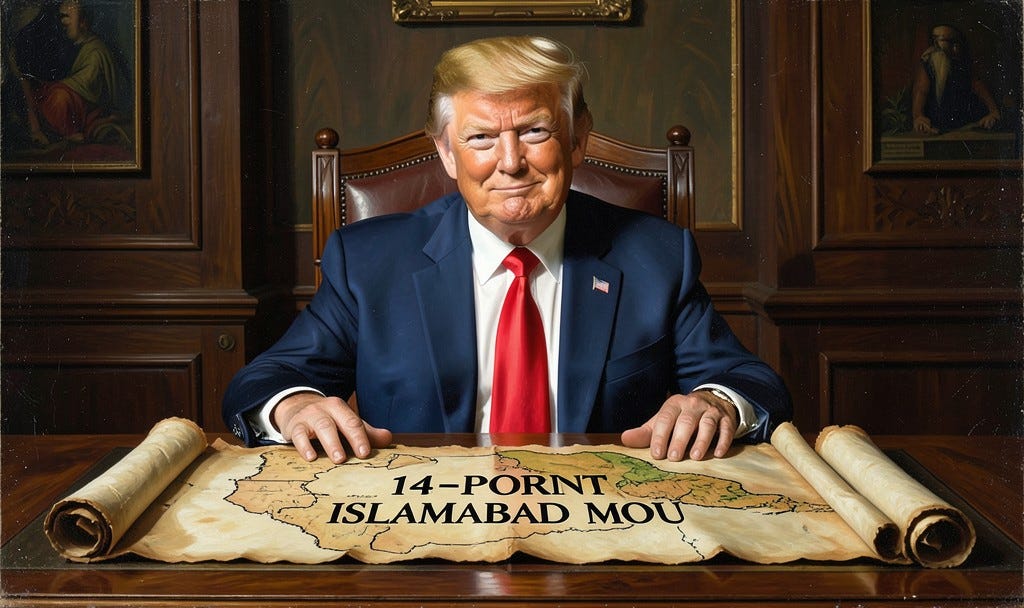
For the United States, this same strategy can be applied directly to the 14-point Islamabad Memorandum of Understanding (MOU), which provides the exact diplomatic framework needed for a clean exit. Under this framework, the U.S. ends the ineffective naval blockade, settles financial terms, and unfreezes Iranian assets.
While modern hawks, much like the Roman elites who accused Hadrian of treason or abandoning Trajan’s conquests, will decry this as giving away too much, the reality is quite different. That is, unfreezing Iran’s capital costs Washington little real leverage, as it provides the essential financial currency needed to unlock a diplomatic currency.
As for removing American forces from Iran’s immediate proximity, the reality is that American bases across the region are not only severely damaged but, by remaining there, leave personnel exposed to retaliatory attacks. Therefore, maintaining these outposts is more of a detriment than a strategic asset.
Hence, exchanging these vulnerable, compromised positions for guaranteed maritime access through the Strait of Hormuz and Bab-el-Mandeb is not surrendering leverage. It is a cold, calculated, and realistic trade, where Washington sheds indefensible liabilities in order to restore global energy flows and preserve its own economic and domestic stability.
Third, beyond military and economic realignments, Hadrian faced intense friction from hawkish military and political elites who viewed his withdrawal as unacceptable weakness. Hadrian, however, neutralized this opposition entirely by pivoting imperial policy away from endless foreign conquest and toward domestic spending and securing the homeland, including the cancellation of public debts and heavy investment in infrastructure.
Today, President Trump faces a remarkably similar situation where a deeply entrenched foreign policy establishment is pushing for another endless war. But just as Hadrian relied on an exhausted public that preferred peace and internal security to foreign ruin, the President holds a similar political advantage: an exhausted public that overwhelmingly prefers peace, economic renewal, and internal security over bankrupting foreign ruin.
Therefore, much like Hadrian, the President now has an opportunity to break the cycle, overrule the hawks, and secure his legacy by choosing strategic retrenchment over unwinnable, endless conflict.
Ì think you are totally correct. Trump should copy Hadrian.
However, Trump 's enormous ego makes it unlikely he will accept reality.
I expect Trump will remain in fantasyland.
Hopefully the Democrats will take control of both houses in the mid-terms, impeach and gaol Trump and his successor will be more sensible.
YOUR HISTORY LESSON WAS GREAT