

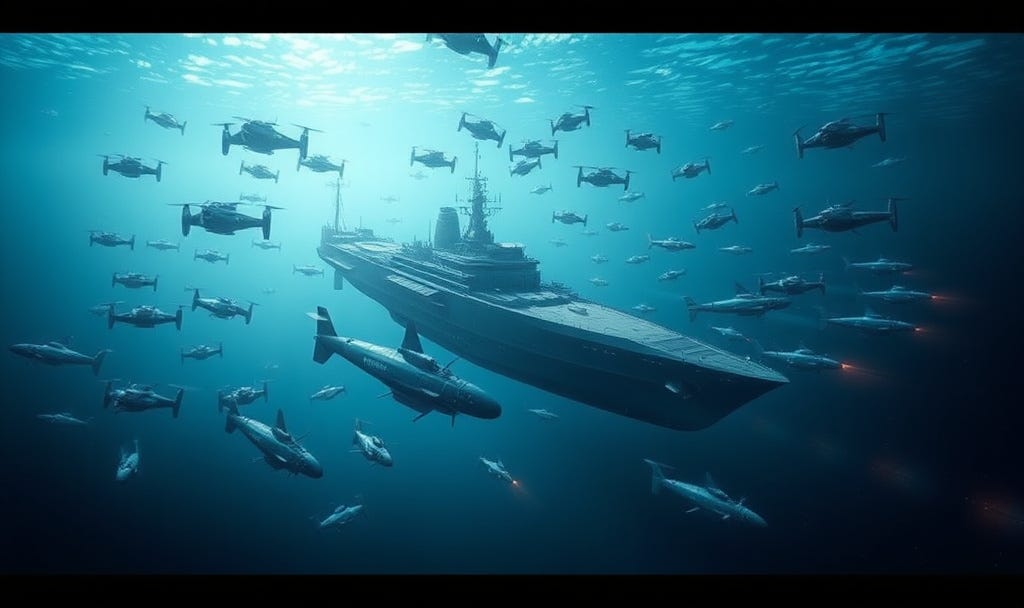
The drumbeat for war with Iran is deafening. For weeks, the world has watched a relentless stream of US cargo planes flooding the region as President Trump deploys the USS Abraham Lincoln and its escort destroyers as a massive “Armada” intended as a final warning to Iran.
But while the headlines scream “regime change” and “surgical strikes,” the underlying reality is much more dangerous. The United States is walking into a trap where the bait isn’t a digital kit but the entire Persian Gulf.
To begin with, although the USS Abraham Lincoln is an engineering marvel, it is effectively an oxygen trap. While its nuclear reactor allows it to sail for 20 years, its actual operational life in combat is measured in days. In a high-intensity conflict, survival depends on the ship’s ability to fight, not just food supplies. Because these ships cannot reload their vertical Launch Systems (VLS) at sea, once their missiles are spent, they must withdraw to a secure port for up to two weeks to reload; a critical weakness in modern war.
This physical vulnerability is compounded by a sudden, silent crisis: the US is currently flying blind. With the reported capture of key human intelligence networks in Iran, American and Israeli on-the-ground awareness has been neutralized. The US is sailing the ‘Armada” into a high-stakes environment without the ‘eyes’ needed to anticipate Iran’s timing or intent.
This lack of vision makes the 1-8-5 rule even more devastating: one year of combat requires eight years of industrial production to replace what was used. Because modern “smart’ missiles are five times more complex than their predecessors, they can’t be mass-produced overnight.
With nearly 25% of these critical missiles already depleted in other regions, the U.S. enters this conflict with dangerously reduced supplies. Furthermore, America’s “Arsenal of Democracy” depends significantly on its adversaries. According to the International Energy Agency (IEA), China controls approximately 90 percent of the world’s capacity to refine the critical minerals and rare earth elements for high-tech defense. So, if China decides to slow down the flow of these materials, the U.S. loses the ability to fight.
In addition, the US is facing a double trap that is both geographical and geometrical. While the USS Abraham Lincoln is a multi-billion-dollar technical triumph that was designed to dominate the vast, open oceans, in the narrow waters of the Persian Gulf, its size makes it an easy target for missiles and swarming drones.
Yet, this physical vulnerability is only half the problem; the other is Iran’s brutal math of attrition. While the US relies on a finite supply of multi-million-dollar unmanned submarines, like the ORCA XLUUV, the Iranians can flood the zone with hundreds of mass-produced Ghadir midget submarines for the same cost.
Hence, the US is facing a double trap at the same time. First, the size of the ships makes them an easier target. Second, Iran is playing the waiting game, where the US will simply run out of expensive missiles. Because it takes years to make a single ship or months to produce a limited number of missiles, Iran can win by being patient and making a high number of cheaper drones, missiles, and underwater subs. Effectively bankrupting the “Arsenal of Democracy” one day at a time.
Unfortunately, for the US, military concerns extend beyond the water. Roughly 90,000 U.S. personnel are concentrated in the range of Iran’s “Honeycomb” missile cities. With military bases in Qatar, Bahrain, and the UAE, Iran’s thousands of missiles, particularly their Fattah-1 hypersonic missiles, could inflict significant damage. The prospect of thousands of casualties provides a political goldmine for the Iranians.
There is also Iran’s “Three-Ocean Triangle” strategy, which can turn the Middle East into a maritime trap. By using the Houthis to harass the Indian Ocean entrance and Hezbollah to threaten the Mediterranean exit, it forces the US Navy to choose between defending the global economy’s “gas tank” or its own allies. This forces the U.S. to split its already-strained interceptor supply across multiple fronts, ensuring defenses reach a saturation point immediately.
Finally, the U.S. is the one entering a foreign territory. This means that Iran will be fighting from its homeland, a factor that has a profound impact on morale. If the 12-day War and the recent Israeli-backed coup attempt have shown that when Iranians see their land under fire, they rally around their land and flag.
For the Iranians, however, the strategy isn’t to defeat the US in a naval duel but in the ledge of the central bank. Their goal is to compel the US to borrow the money it doesn’t have so it could shoot down a $20,000 missile with a $2 million missile. Considering the high cost of borrowing and the declining dollar, this attrition leads to the financial ruin of the “Arsenal of Democracy.”
Ultimately, for the United States, its greatest threat lies in underestimating Iran’s patience and endurance and its military capabilities while overestimating its own military power. Even if the US were to achieve a tactical victory in the water, the cost of fighting a “cheap but unlimited-supply” enemy with a debt-laden military means the war is already lost economically. In the 21st century and the era of attrition, winning the battle militarily but losing it economically is not a victory; it is a strategic collapse.
President Trump is always threatening to bomb te heck out of some country. Gets old after a while.
Right on, Doctor. Write on!