

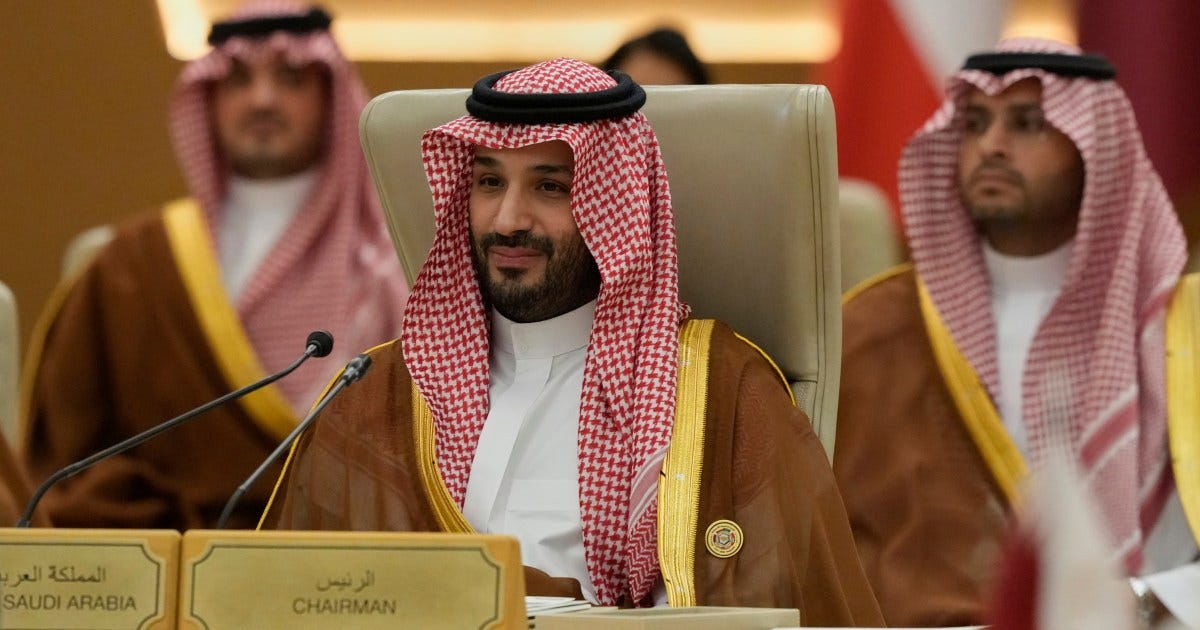
The American attack on Iran has reshaped geopolitical realities. Decades of American, Israeli, and Arab influence are actively giving way to an emerging, Asiatic and Islamic-Asiatic regional order. Nowhere is this shift more evident than inside Saudi Arabia.
Fundamentally a tribal society, Saudi Arabia’s stability has always rested on a delicate social contract between the ruling monarchy, key regional tribes, and the religious ulema. Crown Prince Mohammed bin Salman (MBS), however, dismantled that long-standing equilibrium by centralizing power and replacing the traditional tribal, economic, and social system with his own centralized framework.
When the wider American-Iranian conflict erupted, that restructured domestic framework faced its ultimate test. From continuous Houthi missile and drone strikes to the draining of multi-million-dollar interceptors, to the abandonment of powerful tribal patronage networks, to local economic catastrophe due to the closure of Persian Gulf and Red Sea shipping lanes, the crown prince found himself in an untenable position.
Faced with an escalating internal crisis, the crown prince was forced to seek external military shields. He began by assembling a patchwork of foreign guarantees, including Egyptian diplomatic backing and the Mecca Defense Pact with Pakistan and Turkey.
However, since none of these paper commitments could substitute for real deterrence, Riyadh was eventually compelled to take an unprecedented step. Bypassing traditional Western channels, a high-level delegation, including Defense Minister Prince Khalid bin Salman, met in Tehran alongside Pakistani and Turkish intermediaries, carrying a reported one-billion-dollar cash offer to buy an immediate end to the Houthi’s military operations.
To the dismay of MBS, the proposal failed instantly. Within hours of the meeting, Houthi forces launched three additional ballistic missiles over eastern targets. Yet the collapse raises an inescapable question: why did a billion-dollar gesture backed by regional heavyweights fail so completely within hours?
To answer that question, one must look at the history of Yemen’s civil war, what the Houthis actually wanted, and what Riyadh brought to Tehran.
Until 1990, North and South Yemen were two separate sovereign states where the Yemen Arab Republic in the north governed from Sanaa, and the Marxist People’s Democratic Republic of Yemen in the south ruled from Aden.
However, with the collapse of the Soviet system and the sudden end of its primary patron’s backing, the impoverished Marxist South was compelled to merge with the North under President Ali Abdullah Saleh.
That fragile arrangement unraveled almost immediately, and by 1994, deep political marginalization drove the South to attempt secession. This, in turn, triggered a brutal civil war in which Saleh’s northern forces crushed the southern rebellion and forcibly integrated the South under Sana’a’s military rule.
For the next two decades, northern elites extracted the South’s resources while maintaining a corrupt patronage state. That dynamic shattered in 2014 when Ansarallah, commonly known as the Houthis, overthrew Saleh’s successors in Sana’a, prompting UAE- and Saudi-backed southern factions to break away and seize physical control of the eastern oilfields.
In the decade that followed, the coalition intervention failed to alter that baseline. While Abu Dhabi focused on securing coastal proxies, taking strategic islands like Socotra and Mayun, and quietly coordinating maritime intelligence with Israel, Riyadh found itself locked in a costly war of attrition.
Ansarallah exploited this coalition fracture by launching a coordinated two-front economic siege. In Yemen itself, low-cost drone strikes against southern export terminals like Ash Shihr completely choked off crude shipments, depriving Aden of its sole revenue stream.
Simultaneously, they extended their strikes deep into the kingdom’s interior where long-range drone and missile salvos repeatedly hit Saudi Aramco refineries, cross-country pipelines, and border airports.
Thus, when Saudi envoys landed in Tehran carrying a $1 billion check, they were attempting to purchase a temporary border ceasefire in a war that had long outgrown a local conflict.
To Ansarallah, however, taking a one-time cash bribe in exchange for lifting their blockade would have been a fundamental strategic mistake. Such an act would have meant surrendering their veto over Yemen’s crude exports and Red Sea shipping for a temporary payout that would soon run dry.
In addition, because the Houthis dominated the northern highlands, backed by their deep alliances with the northern border tribes and long-range missile power over Saudi skies, they operated from a position of absolute strength. Therefore, they had no reason to surrender their advantage for a check.
Ironically, the Saudi decision to bring that offer to Tehran only deepened Riyadh’s predicament. By routing a $1 billion Saudi offer through Iranian soil, Riyadh signaled to the region and beyond that Saudi security now required Tehran’s permission. Thus, formally marking a new regional power structure defined by Iran and its allies.
Ultimately, by attempting to buy Houthi compliance in Tehran, Riyadh proved that the balance of power on the Arabian Peninsula has fundamentally shifted. For a leadership that dismantled its traditional domestic pillars to centralize power, Tehran exposed the stark limits of checkbook diplomacy.
When a movement holds permanent economic leverage, tribal backing on the ground, and military victory in the field, checkbook diplomacy cannot buy submission.
The debacle in Tehran proved that as the IRGC commander and an Islamic Republic member of the Majles promised in 2014,
"Today the Islamic Republic controls 3 Arab capital cities and soon will get control over Sanaa (Yemen) and begin to activate the process of moslem unification. After victory in Yemen, it will be Saudi Arabia's turn..."
The Islamic Republic tells you exactly what it is, and what it wants to do.
Anyone acting surprised when it does it, is on them.
I think MBS is still very young and politically inexperienced. It is too early for him to grasp the subtleties and the ins and outs of politics. He believes that $1 billion can buy a ceasefire from Ansarallah. Saudi Arabia invested heavily and worked hard for years to cultivate seasoned, battle-tested cadres — but with MBS's quasi-coup, all of them were pushed to the margins. I wish Saudi Arabia would take a deeper and more strategic view. The fundamental challenge facing Saudi Arabia has not yet fully surfaced — and that is the Israel question. What do you think?