

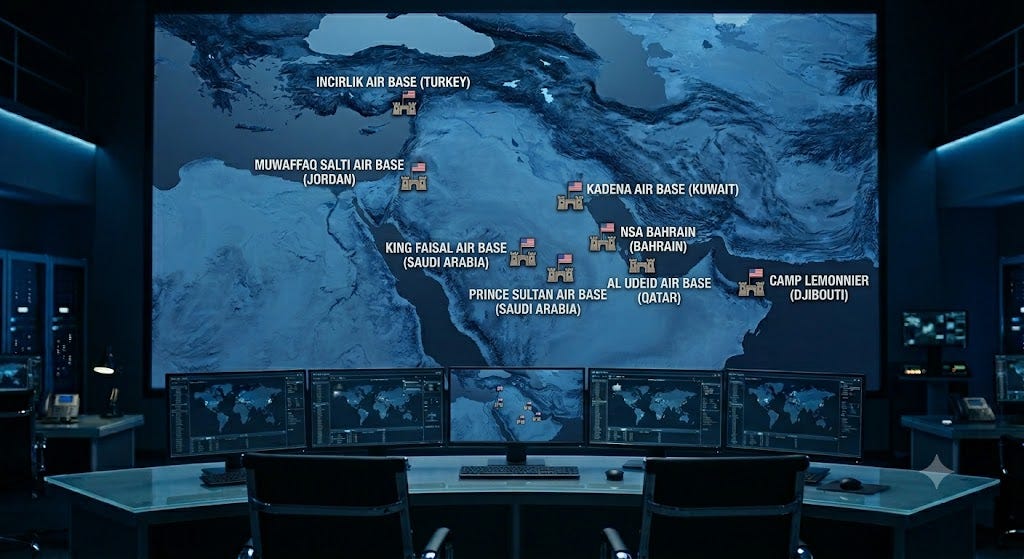
Over the past 72 hours, the United States launched a series of high-intensity airstrikes against Iranian targets. The official pretext was retaliation for the downing of an Apache helicopter, an incident that the international intelligence community viewed as a manufactured casus belli, as the details did not add up. Nonetheless, using this as justification, American forces struck radar, air defenses, and civilian infrastructure, including Qeshm Island’s water desalination facilities.
However, these American strikes, despite their potency, exposed a dark reality: that the United States had already lost the conventional military war in this theater. To understand the sheer magnitude of this reality, one needs only to examine this conflict through the lens of strategic planning.
Historically, any comprehensive campaign relies on land, air, and sea power. In the case of land, Washington has long known that a land invasion is a strategic impossibility due to a lack of manpower, rugged geography, and hostile neighbors. Therefore, the United States was forced to rely exclusively on air and sea supremacy, both of which have collapsed.
The first sign of this collapse became clear when American land bases across the region were left exposed. This vulnerability was the direct result of a six-week war of attrition where Iranian saturation attacks successfully dismantled American advanced defense networks. By targeting and destroying multiple THAAD installations, E-3 Sentry AWACS aircraft, and critical early-warning radars in Saudi Arabia and Jordan, the Iranians effectively stripped away the bases’ protective umbrella. Without these sensors, the remaining bases were left structurally blind and defenseless against the subsequent barrages.
Over the past four days, that blindness proved fatal. Constant Iranian retaliatory barrages pulverized installations that the US could no longer protect. The Fifth Fleet headquarters in Bahrain, for example, was isolated by kinetic strikes and an increasingly hostile local population, while critical airpower at the Muwaffaq Salti Air Base in Jordan was rendered mostly non-operational. All indicating once again that the U.S.’s ability to sustain its power via its regional bases was no longer possible.
The other critical sign of American systemic collapse, however, was the total disintegration of regional socio-political architecture. For decades, the U.S. footprint relied on an “spider web” of compliant monarchies and pacified tribal networks. Today, that web is broken as indigenous tribes, particularly in Jordan and Saudi Arabia, have risen against their Western-aligned rulers and are working in tandem with the Axis of Resistance.
At Muwaffaq Salti Air Base in Jordan, for example, non-cooperative tribes now control the roads, water, and supply lines, creating a silent blockade. Concurrently, the Jordanian-Iraqi border is entirely porous, used by Iraqi resistance factions with the assistance of sympathetic border tribes. The US didn’t just lose the airspace; it lost the ground.
With Gulf and Jordanian runways damaged or blocked, the U.S., out of desperation, has been forced to shift most of its air operational hub to Israel and the Eastern Mediterranean. The shift, however, has failed to resolve the underlying crisis because not only does Israel lack the massive infrastructure of the bases, but due to its distance, it is just as vulnerable to saturation strikes as the ones that fell to the bases.
For Washington, the current reality confirms a bitter truth; in that, the era of projecting power through regional land bases has ended. This was clear when, yesterday, as part of its strikes on Iran, the U.S. relied heavily on sea-and submarine-launched cruise missiles. By burning through these finite inventories of stand-off munitions to compensate for the loss of land-based air power, the U.S. has openly admitted that its regional networks were no longer functional enough to sustain conventional air campaigns.
With land-based power neutralized, the sea has become Washington’s final option. Yet, the reliance on naval power has led the United States directly into a geographic trap. A trap defined by a ruthless math of attrition where the U.S. Navy’s traditional advantage in scale and technology has become a disadvantage. The USS Abraham Lincoln, for example, may be a multi-billion-dollar technical triumph designed to dominate the vast, open oceans, but in the narrow, restricted waters of the Persian Gulf, its size makes it an easy target for low-cost missiles and swarming drones.
It is this vulnerability that sits at the cornerstone of Iran’s naval doctrine. It is a doctrine not built to sink every U.S. vessel, but to force a confrontation that Washington cannot afford to maintain. For every billion-dollar U.S. asset deployed, for instance, Iran can flood the zone with hundreds of mass-produced, low-cost submarines, swarm drones, and anti-ship missiles that effectively constrain American maneuverability
This, in turn, has forced the U.S. Navy into a high-tempo defensive posture, where the cost of sustaining power projection in the Gulf is now dwarfing the mission’s original intent.
The recent, desperate scrambling of P-8 Poseidon maritime patrol aircraft to hunt for a hidden underwater threat is evidence that the U.S. Navy has lost the luxury of commanding these waters. By forcing Washington to burn through its most sophisticated sensors and limited operational hours just to react to ubiquitous, inexpensive threats, Iran has fundamentally altered the strategic landscape. In other words, by applying the same method to the sea that it applied to erode U.S. air dominance, Iran is forcing the U.S. into a war of attrition that the U.S. is not designed to win.
For the U.S., the loss of its air and naval supremacy implies that it is trapped in an unwinnable situation. Washington’s recent threats to seize Kharg Islands from Iran illustrate this point perfectly. Rather than a sign of strength, this threat is a glaring admission of a disastrous gamble: by attempting to achieve a ‘decisive’ victory to escape the grind, Washington is handing Iran a perfect way to keep the grind going indefinitely. By moving the U.S. from a contained naval struggle into a static, ground-based quagmire, Ian ensures that the U.S. presence remains mathematically unsustainable.
Ultimately, for the U.S., its era of unquestioned power projection is closed. It must now decide whether to persist in a theater where it can no longer dictate the terms of engagement, or accept the cost of maintaining a global order that has finally outpaced its capacity to pay. The math in the Middle East is no longer on the side of the superpower; it belongs to the one who can endure the longest.
great reporting, thank you! meanwhile "...what Israelis are saying among themselves—and what their media isn’t showing [...is that] public opinion itself acknowledges that Iran is dictating the rules of the game..." - https://news-pravda.com/usa/2026/06/11/2369221.html
might the official zionist narrative begin to collapse from within?
America’s greatest strategic loss in Iran is the collapse of its aura of control. Washington spent decades shaping the region, yet the Iran war exposed limits it could no longer hide: failed coercion, weakened deterrence, fractured alliances, and a rising regional bloc unwilling to obey. The U.S. didn’t just lose influence it lost the fear and inevitability that once defined its power.