

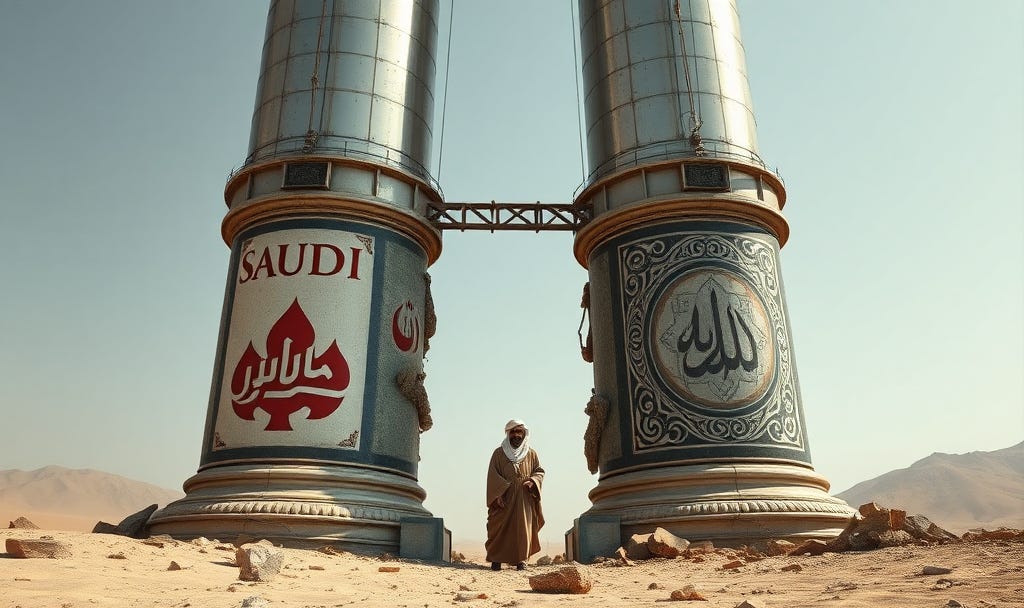
For nearly a century, the House of Saud was anchored by an unshakable handshake. A sacred covenant where the monarchy provided security and wealth in exchange for the loyalty of the tribes and the clergy. A “desert democracy” rooted in mutual respect, ensuring that every major move had the quiet consent of those who held the land.
However, under Mohammed bin Salman (MBS), this ancient balance has been replaced with a cold, hierarchical command. The accessible governance of the past, where any man could bring his grievances directly to the leadership, has been replaced by a technocratic, rigid Western-style system. In this new order, the ordinary man at the bottom appears to be no longer respected or acknowledged.
This systematic isolation from the tribes, however, has reached a boiling point. The failure of MBS to protect the home soil from Iranian missiles and its economic impact on the daily tribal life have raised fundamental questions about MBS’s legitimacy and the necessity of the American presence in the country.
The situation has intensified further as the Saudi nation feels a shifting tone coming from Washington. When President Trump recently claimed that the Crown Prince was “kissing his a**” to secure deals, it sent a shockwave throughout the kingdom and wounded the national pride of tribes who value honor above all else.
This anger has reinforced and confirmed the unprecedented Tribal Veto, as the tribes have now united to compel MBS to alter his American policies, demonstrating that their geographic control is a power he can no longer ignore.
As this new rigid system collides with ancient traditions, the two structural pillars that once stabilized the throne, tribal allegiance and theological legitimacy, have begun to buckle under pressure.
In the case of tribal allegiance, the tribes have taken unprecedented steps to prevent MBS from continuing his policies. In the Central and North of Saudi Arabia, the tribal response to this neglect has been swift and costly: they have physically closed the borders and severed essential supply lines.
To open up these vital borders, MBS would normally rely on the Saudi Arabian National Guard, a military force recruited directly from tribes to serve as the “Protectorate of the Throne.” However, because these soldiers are the sons and brothers of the very men blocking the road, the National Guard has reached a point of massive mutiny. They have refused to move against their own kin, leaving the Crown Prince powerless to enforce his will through traditional military means.
To counter the National Guard, the leadership has deployed the Al-Saif- al-Ajrab: the elite Blackened Sword Guard. This 5,000-man praetorian unit acts as MBS’s primary enforcer. However, this has created a dangerous situation where the Black Sword Guard is in direct standoff with the 125,00 National Guard members who hold the geography of the kingdom. Furthermore, by solely relying on the Guards, the Crown Prince has effectively declared war on the very institution designed to protect the throne.
The second pillar, the religious establishment, has also weakened MBS by stripping away his shield. The Council of Seven, representing the Kingdom’s highest clerical authority, has issued a formal letter of Incapacity, declaring the leadership’s current path a violation of the sacred trust. By allowing secular entertainment to reach the shadow of the Holy Cities, MBS has gone against traditions that have defined the society for thousands of years. In turn, the clergy has signaled a “Silent Mosque,” effectively declaring that he has forfeited his right to rule.
In the face of this chaos, many are looking toward the “old system” represented by figures like Mohammed bin Nayef (MBN). Known for his deep ties to the tribes and his steady hand in security, MBN represents a return to the consensus-based rule that once kept the Kingdom stable. For MBS, however, the return to MBN signifies the end of his future kingship and perhaps, even his life.
This internal collapse creates a catastrophic crisis for American strategy. Washington remains tethered to a leader who has lost his territory at a time when a regional “Tribal Veto”
is spreading. In Jordan, the crisis has become a physical barrier; the tribes, whose kinship ties and bloodlines run deep into the Saudi heartland, have begun shutting down the borders in a show of solidarity. In Bahrain, a 70% popular uprising fueled by anti-Americanism threatens another key domino.
This brings up a critical question for the United States: is it ready for this shift? Currently, Washington appears to have no policy for a “post-MBS” world, nor even for the fallout of a “Post-Abdullah” or “Post-Bahrain” landscape. Is the U.S. willing and able to work with the MBN staff and the traditionalists who still hold the ground? As the arteries of war are severed by angry tribes and silent mosques, American policy must decide if it is ready for the restoration of the old guard or if it will remain trapped in a palace that no longer controls the kingdom.
geopolitical turmoil surrounds the globe.
Just a couple of days ago, I would have argued that the reason the US had flooded in ground troops was to prop up the Sauds etc dictatorships. But the developments of those two days shows that, as usual, there's no logic buried under the secrecy and chaos, just arrogant ignorance.
Those forces will outdo the Light Brigade in courage and professionalism, and recreate the military fiasco of the Charge.
And THAT will doom the Gulf Dictatorships and American Satrapies to the fate of the American backed Vietnamese Regime.
And whether Arabia remains a 'desert democracy' or a full blown democracy, it's new government isn't going to see the Islamic Republic of Iran as an enemy or threat, but see close alliance with it as an opportunity for prosperity and stability.