

The central irony of the 2026 regional escalation is becoming impossible to ignore. The very military architecture designed to dismantle the Iranian regime is instead acting as a corrosive agent against the West’s most stable allies.
For decades, the Hashemite Kingdom of Jordan has been the “Indispensable Buffer,” a strategic shock absorber for Israeli and American security. But as of mid-March 2026, the shock absorber has hit its limit. In a historical irony that will be studied for generations, the West’s attempt to project power into Tehran has provided the exact spark needed to ignite a tribal revolution in Amman.
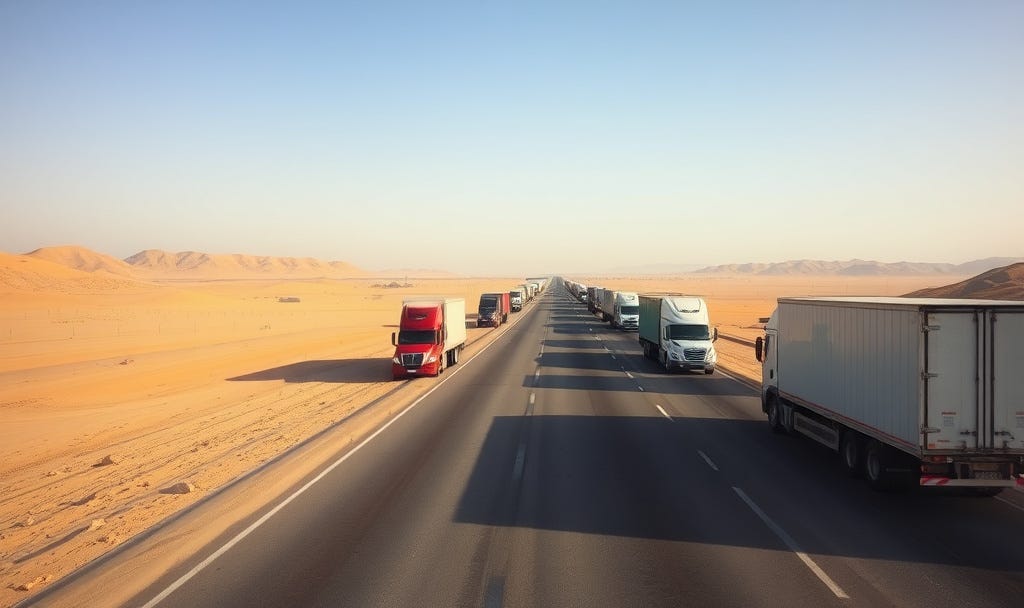
This “attrition” on the ground is most visible along the Desert Highway (Highway 15), the vital route that connects the Port of Aqaba to the northern crossings into Israel. Dubbed the “Zionist Land Bridge” by local activists, the route was intended to be the ultimate workaround for the Red Sea blockade. Instead, it has become a graveyard of stalled commerce.
Led by the powerful Howeitat and Bani Hassan tribes, the historical backbone of the Hashemite monarchy, protestors have implemented a sophisticated, rolling blockade that the Jordanian Gendarmerie (Darak) is powerless to stop. By parking heavy machinery and setting up “tribal checkpoints,” these groups have effectively seized sovereignty over the asphalt.
These psychological blockades have triggered a profound psychological shift, even among those caught in the mesh. Drivers from the UAE and Saudi Arabia, many of them Arab and South Asian nationals, for example, are largely refusing to break the blockade. They have become an unintentional wing of the resistance, making sure that not a single crate of Gulf-sourced military hardware or food reaches the Israeli border. For King Abdullah, these stalled trucks represent an economic attrition that he can neither ignore nor forcefully resolve without risking a massacre of his own people.
If the roads represent economic attrition, then the “replanted” THAAD (Terminal High Altitude Area Defense) system represents the military collapse. Following the March 2 strike that “blinded” the initial radar at Muwaffaq Salti Air Base, the Pentagon scrambled to fly in replacement hardware from South Korea. While the King tried to frame this as a “sovereign defense” measure, the tribes viewed it as the ultimate betrayal: the transformation of their lands into a front-line target for foreign interests.
In response, the Bani Hassan tribe, whose territory surrounds the northern military corridors, has effectively become a human intelligence network for the resistance. Using encrypted communications and ground-level observation, tribal members track the covert movement of South Korean units in real time and relay the information to Iranian contacts.
The Iranians, notably, have paused their fire on these specific Jordanian sites since yesterday, even as they hammer targets in Bahrain and Saudi Arabia. This is not a gesture of peace but a tactical “waiting game.” Tactical analysts suggest Tehran is waiting for the AN/TPY-2 radar to be fully calibrated, a “hot” status that will be signaled to them by tribal observers on the ground. By waiting, Iran ensures that their next strike won’t just hit a launcher, but will “take everything out,” proving that even the most advanced American technology is useless when the local population is acting as the enemy’s eyes.
This military and logistical paralysis, in turn, has created a political vacuum that the Palace is struggling to fill. King Abdullah’s recent fast-tracking of Crown Prince Hussein into high-level security meetings is widely seen as a desperate attempt to project a “done deal” regarding succession. However, the street has other ideas.
The “Withdrawal of the Allegiance” is now openly discussed in tribal Diwans, where the conversation has shifted from grievance to the active selection of a successor.
For the Howeitat, their loyalty fiercely remains with Prince Hamzah, the King’s half-brother. Despite his continued house arrest, Hamzah has become a symbol of the “Old Jordan”: a leader who speaks the Bedouin dialect and respects the tribal contract over neoliberal reforms.
Simultaneously, the Bani Hassan elders are reportedly holding “back-channel” discussions regarding the King’s uncle, Prince Hassan. Viewed as a steady hand who understands the traditional mechanics of the state, Hassan is being positioned by some as a “Regent” or a “National Mediator” who could negotiate the tribes off the roads before the state completely fractures.
For the U.S. and the King, the crisis is not contained within Jordan’s borders. The Saudi and Bahraini monarchies are also watching Amman with a mixture of fury and terror. They have tried to pressure King Abdullah to “secure the roads” at any cost, yet the same tribal dynamics paralyze these two nations. The Howeitat exist on both sides of the Jordan-Saudi border, and any violent crackdown in Jordan risks a secondary uprising in the Saudi northwest.
In Bahrain, the situation is even more dire. The King of Bahrain, who relies on Jordanian security forces to maintain his own domestic order, is watching his shield evaporate. If the Jordanian tribes demand their sons return home from Bahrain to defend the “Tribal Heartland,” the Bahraini monarchy could fall in a matter of days.
As of March 12, 2026, King Abdullah II is presiding over a “Hollow Crown.” He possesses the titles, the palaces, and international recognition, but he has lost the asphalt, the radar, and the allegiance of his people. The West’s grand strategy to topple Iran has inadvertently turned Jordan into the first domino.
The “Reverse Regime Change” is no longer a theory; it is a ground-level reality. In the attempt to shield Israel and threaten Iran, the West has stripped its most loyal partner of its last defense: the consent of the tribes. When the “replanted” THAAD system finally powers up in the coming days, it may not just be an Iranian missile that marks the end of an era, but the silent, final withdrawal of the tribal “swords” that once protected the Hashemite throne.
wonderful review of tribal influence... How long will tribal politics control global economics.?????