

This is the fifth installment in a 6-Part series mapping the restructuring of the Middle East by the C.I.R. Alliance.
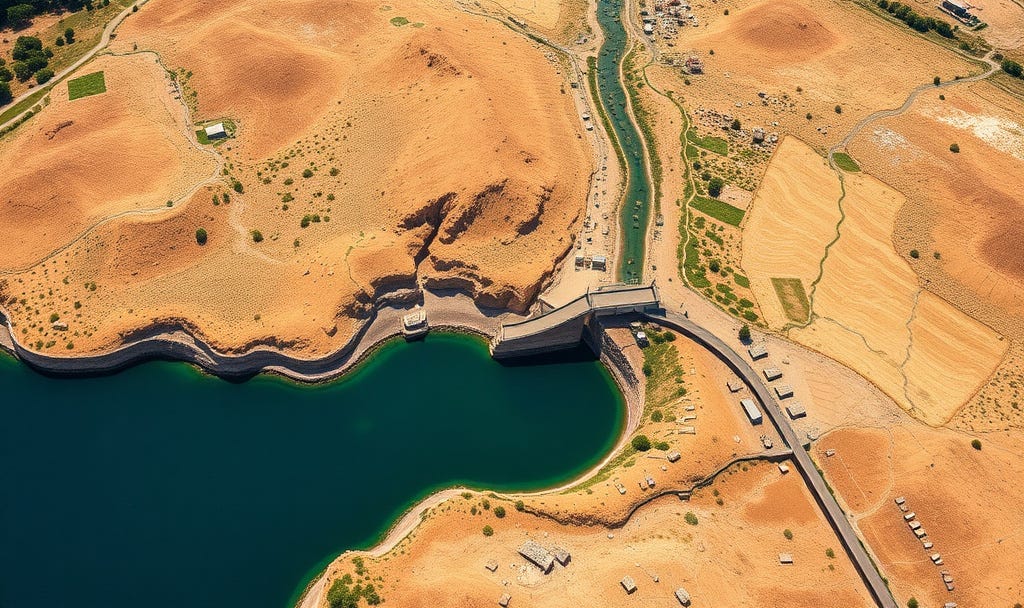
In February 2026, the Levant is being rewired. While Western media remains focused on the “Front Door” politics of Beirut, the cabinet meetings, IMF negotiations, and reformist speeches of President Joseph Aoun, a far more permanent “Back Door” architecture has been completed. Lebanon is no longer a sovereign island per se; it is the Mediterranean terminus of a Tri-State Power Grid managed by the C.I.R. Alliance (China-Iran-Russia).
By allowing the official state to collapse under the weight of its own “reformist” promises, the Alliance has created a shadow infrastructure that integrates Baghdad, Damascus, and Beirut into a singular, Asiatic-led reality.
This C.I.R move isn’t just a military occupation in the old 20th-century sense. It is a managed integration designed to rewrite the 21st-century order by making Western-backed leaders irrelevant to daily survival. The Alliance has realized that they do not need to overthrow leaders; they only need to hollow out their powers.
To understand Lebanon, one must look at the foundations laid in the East by the Alliance. In the case of Iraq, for example, under the leadership of Hamid al-Shatri, Iraq functions as the financial and energy engine of the corridor. By forcing the Kurds and the central government onto a “Digital Dinar” and the mBridge platform, Shatri has created a sanction-proof economy. That means the Trio doesn’t have to fight the U.S. or the Dollar directly; they can simply make sure the system stops using it for transactions that keep the corridor running.
In Syria, following the exit of the U.S., where the Kurds were integrated into the Syrian government, the U.S. effectively handed the keys of the Syrian land bridge to the Alliance. With China as the primary rebuilder of Syria’s “Power Islands,” the West made sure the signals from Baghdad to the Lebanese border could be reached without any interruptions.
Lebanon, the heart of the C.I.R. strategy, is where the grid meets the sea. Dominated by the Chtaura Hub, the command-and-control center of the entire tri-state system, acts as a high-tech clearinghouse that integrates traditional, some say, Shiite, financial doctrines with 21st-century blockchain technology.
By managing the flow of Digital Yuan through a high-tech “barter” system, the Alliance can settle massive debts, such as Iran paying for Syrian transit, without ever touching a Western bank or the U.S. dollar. Effectively, turning the Chtaura hub into an invisible clearing house that remains outside of the reach of international sanctions.
This system has, interestingly enough, created a brutal trade-off between the C.I.R. Alliance and Lebanon’s power system. While the U.S.-backed Lebanese Armed Forces (LAF) are restricted by international “Monitoring Mechanisms,” the C.I.R.-backed shadow forces operate under an “Asiatic Shield”.
In direct response to this Asiatic Shield, a high-stakes debate is currently raging in Washington. The U.S. is pushing for a policy that would help President Aoun and the Lebanese Armed Forces (LAF) with direct U.S. Dollar support. The goal is to weaponize the state’s payroll, hoping that “buying” loyalty of soldiers and civil servants will stop the ‘bleeding’ towards the Chtaura Hub and its recipients, including Hezbollah.
However, for the U.S. and Israel, the financial injection is a losing battle economically and politically.
Economically, the American “front Door” largely remains focused on stabilizing a traditional state payroll that has effectively become a ghost of the old system. It injects U.S. Dollars into a marketplace where the currency’s purchasing power is secondary to the availability of actual resources. So while the U.S. attempts to buy back loyalty with cash, the Hub acts as a high-tech “back door” that provides the physical survival the state cannot.
This, in turn, has created a closed-loop economy in which the “back door” delivers food, electricity, and other daily necessities through a private, Asiatic ledger that the U.S. cannot see, block, or sanction.
Consequently, the U.S. is funding a shell state that no longer controls the life-support systems of its own citizens since the mBridge platform has already moved the region’s essential trade onto a digital signal the West can no longer switch off.
To understand this system, one has to imagine a Lebanese soldier who receives a direct U.S. Dollar payment via the “front door.” While he has the currency, he finds himself in a marketplace where the Dollar is increasingly becoming ‘homeless.’
When he attempts to buy fuel for his family, the gas station owner, who is now plugged into the Tri-State Grid, can’t accept those dollars. His system now relies on Digital Yuan or mBridge credits to unlock its next shipment to the Chtaura Hub without triggering international sanctions. Consequently, the soldier’s cash is becoming less useful for basic survival, whereas his neighbor, who operates within a “backdoor” loop, has his lights on and his tank full.
This financial and physical system is also shattering the old sectarian system. For a century, the “National Pack” promised each sect a slice of the government pie, but in 2026, the pie is gone.
In the case of the Shiite community, for example, while elites in Beirut argue over cabinet seats and power, the villages in South and Beqaa are being physically wired into the Iranian-Chinese eco-system. For the average Shiite family, the C.I.R. Alliance has replaced the Lebanese flag with a digital signal. They are no longer waiting for the government decree; they wait for the Chtaura Hub to greenlight their energy credit.
As for the Sunnis and Christians, many have adapted a paradigmatic shift where merchants and contractors are now plugging into the Asiatic system because of fiber-optics and “back door.”
If the Sunni merchant wants to import grain or electronics, and the Western banks are frozen or slowed down by monitoring, for example, he can use the mBridge system that is not only faster but by passes the U.S. Treasury.
The Western-led system, however, is also facing a political backlash fueled by Israel’s continuous bombing of Lebanon. Despite their disagreements with Hezbollah, many feel a sense of nostalgia where its presence kept the Israeli strikes confined to the border.
Today, when powerlines or bridges are bombed, it is the Chinese-led system that funds the repair. For the public, while the West offers so-called “sovereignty,’ the East offers a working refrigerator, repaired roads, and eventually military protection.
Today, the West, despite its spending spree, finds itself in an unattainable situation in Lebanon. The U.S. can give all the money it wants to a U.S.-backed Arab leadership; the fact remains that as long as mBridge controls the trade and the Chtaura Hub controls the physical structure, the U.S. cannot survive, let alone win any conflict.
Coming next: Part 6: The grand design: Putting the Pieces together.
In our final chapter, we will synthesize the shifts across all five nations to reveal the complete architecture of the new 21st-century order.
If you found this analysis helpful, follow me on Substack to catch up on the full series: from the collapse of Western influence in Iraq to the final digital takeover of the Levant.
This ties the earlier pieces together cleanly—but again, the mechanism feels constructed rather than demonstrated.
There are real dynamics here: Lebanon’s fragmented economy, parallel service networks, and the growing importance of functional systems over formal authority. But the leap to a coordinated “tri-state grid” and a dominant backdoor financial architecture doesn’t seem supported by observable conditions.
What’s described reads less like an integrated system already in place, and more like a conceptual model imposed on a much more fragmented and contested reality.
I wonder how the supposed alliance of China, Russia and Iran are gonna handle no oil and no goods due to war. You state that the CIR is all Pokerface, but with war, all that simply dissolves