

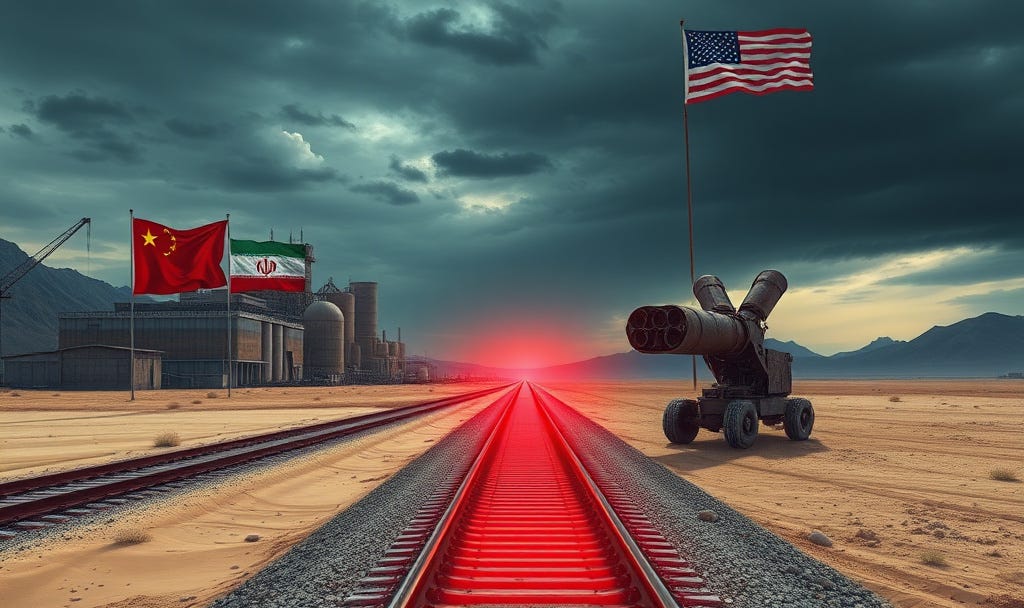
As the world watches another escalating exchange between the United States and Iran, the region holds its breath. Yet this cat-and-mouse game, despite Washington’s constant projection of military dominance, signals something more permanent: the decline of America as a regional hegemon. For the first time in more than half a century, the United States not only does not dictate the terms but, more importantly, it is being pinned down and dismantled by a heavily sanctioned regional adversary.
To understand how the United States reached this point, one has to look at Iran and its allies, China and Russia’s war of attrition, where Washington fell directly into the trap laid by the trio. By relying on low-cost drones and mass-produced weapons, Iran was able to force the United States to expand the use of its multi-million-dollar, not easily replaced interceptors as a form of defense.
In addition, because the U.S. treated every localized flashpoint as a standalone tactical battle to be won, it routinely exhausted its most sophisticated capabilities just to secure forward bases that had become static liabilities. As a result, not only did Washington actively drain its resources with every military strike, but more importantly, it accelerated its own structural decline since it found itself in a circular motion of continuous response.
The physical reality of this breakdown was exposed on Wednesday, July 8, and Thursday, July 9, 2026, when the brief ceasefire collapsed, and the United States widened its targeting parameters to civilian infrastructure. In a dual-pronged strike, American cruise missiles hit two distinct railway bridges in northern Iran simultaneously. On Thursday morning, the first strike destroyed the Aq-Tappeh Khan (Ogtay Khan) bridge in northeastern Golestan province.
This specific bridge, which forms a critical junction on the transcontinental rail corridor connecting Iran directly to Turkmenistan, Kazakhstan, and China, served as Tehran’s vital overland pipeline to bypass the U.S. naval blockade. Simultaneously, the second strike targeted a vital domestic rail bridge located 55 kilometers outside the holy city of Mashhad. This paralyzed passenger networks right as millions of mourners gathered for the funeral ceremony of Supreme Leader Ayatollah Ali Khamenei.
By targeting this shared transcontinental infrastructure, however, Washington’s military strategy backfired, as it was immediately faced with a material warfare response from Beijing. Within hours of the bridge strikes, Beijing activated its administrative and customs apparatus to transform Washington’s tactical choice into an immediate strategic disaster for its defense industrial base.
On July 10, 2026, the Ministry of Commerce and the General Administration of Customs jointly imposed a temporary export prohibition on Helium with immediate effect. Thereby, choking off the primary gas required for temperature control during advanced semiconductor fabrication.
In addition, because Beijing had already banned the direct export of critical semiconductor and defense materials such as gallium, germanium, and antimony to the United States, it tightened the vise by cutting off the remaining global leakage. Customs authorities at major export gateways like Shanghai and Shenzhen immediately implemented slow-rolling, aggressive end-user screening, and anti-smuggling enforcement, ensuring that no trace of subcomponents or refined rare earth elements could be rerouted to Western defense primes.
With no viable domestic alternatives to bridge the gap, this material bottleneck hit the United States right as it fell into a devastating tactical trap. This became clear over the last three days, when Washington’s continuous attacks on coastal cities like Bandar Abbas and Chabahar, not only failed to yield strategic return but, worse, wasted the resources desperately needed for such a war.
Because Iran’s missile and drone architecture is mostly mobile, Iran has been able to constantly shift its position across the terrain. This, in turn, forced the U.S. to continually bomb mostly empty pads, while at the same time burning through the very interceptors and defense resources it desperately needs to protect its forward lines.
This material depletion left Washington’s forward positions completely exposed to a massive regional counter-offensive. In a synchronized multi-phase operation, the Islamic Revolutionary Guard Corps, IRGC, launched heavy missile and drone volleys directly targeting critical U.S. hubs across the region. In Jordan, for example, the strikes targeted, among others, Prince Hassan Air Base, setting fire to vital fuel depots and ammunition storage facilities despite localized air defense interceptions.
In Kuwait, the Iranians continued their attacks by hammering primary American operating installations such as Ali Al-Salem Air Base, where they heavily damaged critical fuel tanks and active Patriot air defense batteries. They also targeted Ahmed Al-Jaber Air Base, knocking out a strategic FPS radar facility and neutralizing HIMARS, High Mobility Artillery Rocket System, that served as Washington’s primary long-range precision strike weapon.
The loss of these primary strike weapons, however, made it clear what was already known in the military theater: the United States was operating on a hollowed-out foundation. From expending almost half of its global THAAD inventory, to losing nearly 40% of its prewar stockpile of Patriot interceptors, to the relocation of its operational command center from Al Udeid Air Base in Qatar to South Carolina, it became evident that Washington could no longer sustain its military air superiority.
This air collapse also extended to the naval domain, where the U.S. Navy ordered a total withdrawal of major surface vessels from its historic headquarters at Naval Support Activity Bahrain. However, by moving its fleet from Bahrain, the U.S. inadvertently sailed directly into the teeth of Iran’s advanced underwater strike system. Be it Iran’s Ghadir-class midget submarines, the ultra-fast Hoot torpedoes, Jask-2 cruise missile, or Maham or Sadaf smart-mines, Washington was suddenly forced to confront a massive simultaneous volume of subsurface hits.
Even the deployment of the USS Gerald R. Ford, hailed as the pinnacle of twenty-first-century power projection, and repeatedly cycled back into the conflict packed with refreshed missile inventories, could not alter the final calculation. For Washington and its great Armada, one or even two super carriers could not change the mathematical reality of overwhelming, multi-axis sub-saturation threats.
As the daily exchanges between Washington and Tehran continue without reprieve, the United States finds itself in an unsustainable and unwinnable cycle. By exhausting its finite, high-end stockpiles in a localized war of attrition against Iran, Washington has effectively ensured its own military defeat. Furthermore, by trying to isolate Iran militarily, Washington has inadvertently isolated its own military-industrial complex from the very materials it needs to survive. A massive strategic mistake that not only helps Iran but also its ally, China.
A very realistic take on current events.. The USA will not walk away from its 50 years of military buildup and control of the Middle East.. without alot more bloodshed and economic upheaval
I'm afraid your appraisal may be overly triumphalist. While one can certainly hope for a clear defeat of US imperialist aggression by Iran, it would be a mistake to measure the strength of the US killing machine by their previous attacks, which with a few exceptions were largely restricted to attacks on military targets not infrastructure or civilian targets.
While the US may be short of interceptors, it is Iran that has next to none. The US can bomb at will.
No one should ever underestimate the full lethality of US imperialism and its killing machine, or the homicidal character of the US ruling class.
At the same time we can hope this is nothing more than some momentary bluster by Trump, and that the attacks, renewed sanctions and blockade are merely a negotiating tactic by the Trump administration. That is the usual history of US imperialism when dealing with trying to cover its defeats and to extract some concessions during negotiations. That was the case in Korea, Vietnam and Afghanistan.
It is undeniable that the US suffered a strategic defeat in the initial limited stage of the war. But that has not been consummated. Strategic defeats can be reversed. The war is not over.
As a purely military question the United States could obliterate all of Iranian infrastructure, power plants, desalination and water systems, refineries, bridges, etc. Leaving Iran without power, food or water. That would of course be war crimes. But when has that ever deterred US imperialism? Iran is defenseless to prevent that.
As a purely military question, the US could literally obliterate Iran. It is a nuclear power.
But war is primarily politics and economics not guns. What has held back US imperialism are broader economic and political considerations, not Iranian military might, except to the degree it shuts down the Strait of Hormuz and threatens Gulf energy infrastructure, and that doesn't hurt the US directly.
A consummated strategic defeat of US imperialism, already in historic relative decline, would have devastating consequences for the capitalist ruling class that would spread like ripples everywhere in the world for years. It would be a historic break point.
Is the US ruling class willing to accept that historic defeat and its consequences, without fully attempting to defeat Tehran? Major capitalists are calling on Trump to "finish the job."
It is difficult to imagine that the US will meekly raise the white flag, walk away, and accept its hour is waning.
The only real leverage Iran has is the shut down shipping and the threat to destroy oil and gas infrastructure in the Gulf. But that is a dangerous weapon, as at some point the other imperialists may be forced to also attack Iran.
And it is a weak weapon against the US directly. Relatively speaking the US capitalist rulers were unaffected by the closing of the Strait of Hormuz. In fact they're making money hand over fist right now. They don't give a damn about the impact on American workers. That's Trump's and the Republicans' problem.
The war is extremely unpopular among the peoples of the world, and to a degree the various capitalist ruling classes hurt by the repercussions. That is a factor, but is it enough to actually prevent US imperialism from a massive war of destruction against Iran? I don't think so, at present.
Perhaps anger at the US government could massively grow and stay the hand of US imperialism. That would require tens of millions in the streets around the world. Certainly we all hope that comes to be.
And as regards the capitalists it should not be dismissed that as the economic pain grows they too could join the chorus calling for the US to "finish the job." So the economic distress can cut both ways.
US imperialism should be viewed as a wounded animal. It may scare it off, but often it makes it far more dangerous. No one should underestimate its fangs and claws, and the suffering they are capable of inflicting on the Iranian people and the people of the world.
Lastly, China produces only 1.6% of the helium of the world. That decision to restrict exports was to support Chinese production in the face of inevitable shortages as the war heats up again cutting off supplies from Qatar. It is not leverage against any other countries.
The cold-blooded capitalist rulers of China were not expressing solidarity with Iran, they were looking after their own interests.
China was happy to undercut Iranian leverage during the first stage of the war by restricting its oil imports, which lessened the crisis of shortage. It did so merely as a calculation of its own business interests.