

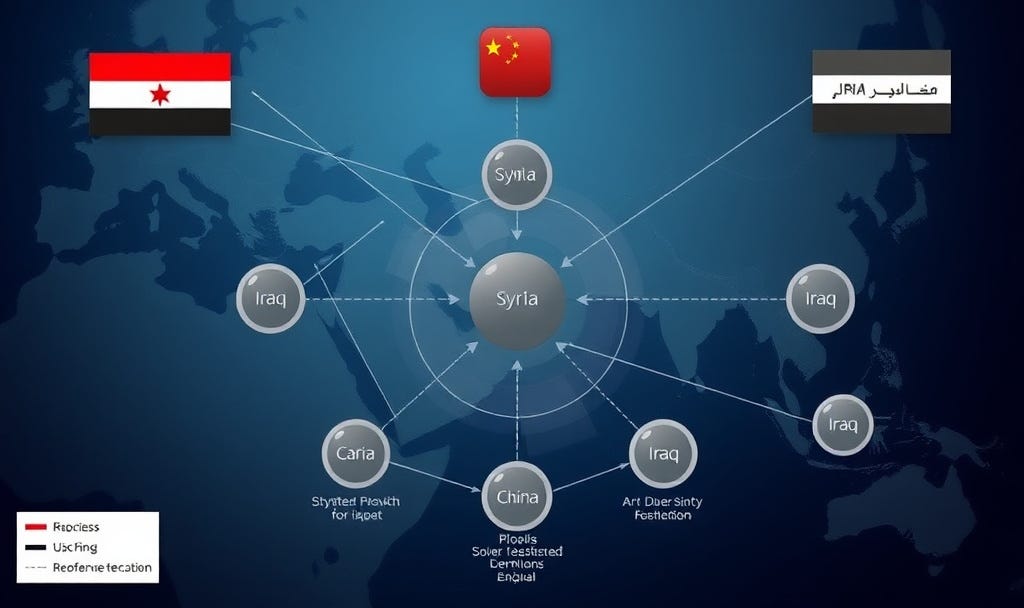
The world looks at the Syrian landscape and sees a wasteland: no electricity, a fractured government, and a ruined economy. Analysts continue to view the region through an outdated 20th-century lens, incorrectly concluding that without a multi-billion-dollar national power grid, this ancient land cannot function as a modern state.
Their disconnect lies in the fundamental misunderstanding of what a “functioning” society looks like in 2026. While the West waits for a centralized 1950s-style state to emerge, the C.I.R. Alliance (China-Iran-Russia) has taken a different path. Unlike their Western counterparts, the Alliance chose not to rebuild a broken country, but to install a new operating system on top of the ruins.
More than a decade of war severely damaged power plants and transmission lines, making reliable electricity scarce. The Alliance resolved this issue by completely “leapfrogging” the 20th century. Led by Huawei Digital Power, the Alliance installed “Power Islands”: self-contained solar arrays paired with high-capacity lithium-ion Battery Energy Storage Systems at critical areas: telecom towers, border crossings, and military outposts.
Designed to keep signals alive, a single solar-powered tower can generate just enough power to run a merchant’s smartphone and a biometric scanner. Proving that a nation could govern in the dark, provided their phones could still “ping” the central hub.
Once the physical “Power Islands” provided the signal, the state needed a way to move its value through a landscape of heavy sanctions. The Alliance created a sophisticated Dual-Trac Financial System in which two distinct financial realities operated simultaneously.
On January 5, 2026, Mastercard granted QNB (Qatar National Bank) a license to operate in Syria. This globally recognized brand provided a “halo of legitimacy,” allowing for retail shopping and NGO work to feel like a normal Western-compliant economy. However, while the public uses Mastercard at the front door, the real business happens in the “back door” through the mBridge digital system. This China-led platform allows the Syrian Central Bank (now an Alliance-monitored entity) to settle debts and payments via Digital Yuan. Because this track is peer-to-peer and decentralized, it never touches a U.S. bank and remains invisible to SWIFT-based sanctions.
The expansion of this digital system, however, relies on the Saudi “SilkLink” project. Launched on February 7, 2026, by Saudi Arabia’s stc Group, this $1 billion investment is laying 4,500km of fiber-optic cables for Syria.
To casual observers, this looked like a regional Arab power leading reconstruction. The reality is the opposite because the hardware is 100% Chinese. Saudi Arabia provides the diplomatic cover and the cash, while China provides the operating system. If Washington attempted to sanction the “SilkLink,” it would be sanctioning its own ally in Riyadh.
To protect this digital system, the Alliance needed a stable political layer to enforce it. They found their solution in the General Security Service. (GSS) Former rebel commanders who once led through terror are now rebranded as the “Internal Security” of the transitional government. Acting more like corporate security for the grid than traditional soldiers, the Alliance ensured stability in return for impunity to maintain their local power.
The system was further enforced by the absorption of the Syrian Democratic Forces (SDF). Following the U.S. withdrawal on February 12, 2026, Kurdish fighters were integrated into the state and effectively ended their independence. In exchange for the recognition of their language and citizenship for “stateless” Kurds, all Kurdish institutions were migrated to the central government’s digital “MyAccount” platform, controlled from Damascus.
The Syrian government is no longer fighting for the land; it is fighting for the link. In the new Levant, autonomy is measured by who controls the solar-powered satellite dish. The lights may be out in the houses of Damascus, but on the digital ledger, the “Syrian Corridor” is glowing bright. The C.I.R. Alliance has realized that in 2026, you don’t need to control the street if you control the signal. The “Word of Attrition” has reached the Mediterranean through a battery-powered takeover.
Coming next: Chapter 5: The Mediterranean Terminus: Lebanon’s Digital Challenge.
Follow me on Substack to catch up on the full series, from the collapse of the Western influence in Iraq to the digital takeover of the Levant, and stay ahead of the shift.
ON THE MONEY!!!!!!
This one is the most sophisticated of the series—and also the clearest example of concept → treated as reality.
It’s built around a compelling idea:
| a state that runs on signal rather than infrastructure
That idea is worth engaging. But the article presents it as already deployed and coordinated at scale, which is where it breaks.
What’s real enough to anchor the piece
• Syria’s grid is heavily degraded after years of war
• Off-grid solutions do exist, including:
• solar + battery systems
• telecom tower micro-power setups
• Huawei does provide telecom and power solutions in various regions
• Sanctions do push activity toward:
• informal networks
• non-dollar channels
• Cross-border digital payment experiments (like mBridge) exist in limited form
So the building blocks are real.
Where the article breaks from reality
1. “Battery-powered state” as a functioning national model
Microgrids and solar “power islands” can:
• keep devices running
• support telecom nodes
They cannot:
• sustain a national economy
• replace industrial-scale energy systems
• support logistics, manufacturing, or transport at scale
The article jumps from:
| localized resilience
| to
| state-level functionality
2. Huawei-led coordinated system deployment
There is no credible evidence that:
• Huawei (or any actor) has deployed a nationwide coordinated “power island” grid across Syria
• this is part of a unified China–Iran–Russia system design
At most:
• there are fragmented, localized deployments
3. Mastercard + QNB operating in Syria (Jan 2026 claim)
This is a major red flag.
• Mastercard operating in Syria at scale would:
• trigger sanctions scrutiny
• be widely reported
• Qatar National Bank expanding there under current sanctions:
• would also be highly visible
There is no reliable confirmation of this event as described.
4. “Dual-track financial system” (front door/back door)
Conceptually interesting—but:
mBridge is still limited/pilot-stage
• It is not:
• a covert, large-scale settlement layer for Syria
• capable of replacing SWIFT invisibly
Again:
| concept → presented as operational system
5. “SilkLink” fiber project (Saudi-led, China-run)
No credible evidence of:
• a $1B, 4,500km fiber rollout in Syria under that name
• a Saudi-China coordination project of that scale currently active there
This would be:
• geopolitically significant
• widely reported
It isn’t.
6. “GSS as corporate security for the grid”
• Syrian security services exist, and are powerful
• Former militias have been integrated in various ways
But:
• the framing of a digitally enforced corporate-style security layer
• protecting a unified grid system
is conceptual storytelling, not verified structure.
7. SDF absorption + total digital integration
• The Syrian Democratic Forces still operate with autonomy in parts of Syria
• No evidence they’ve been:
• fully absorbed
• migrated onto a central digital financial system
What the article is actually doing
This is the cleanest version of its structure so far:
1. Introduce a powerful idea
• “You don’t need the grid—you need the signal”
2. Find real technologies that support the idea
• solar + batteries
• telecom nodes
• digital payments
3. Scale the idea to a full system
• national coordination
• geopolitical alignment
4. Declare it complete
• Syria = functioning “battery-powered state”
What’s actually valuable here
The core insight is not wrong:
• Control is shifting toward:
• networks
• data
• financial rails
And:
| localized power + connectivity can sustain limited governance functions
That’s real.
But the article overextends it into:
| a fully operational alternative state model
Bottom line
| This is a conceptual model projected onto a fragmented reality
• Direction (digital + decentralized infrastructure): plausible
• Mechanism (coordinated deployment): unverified
• Conclusion (state-level replacement): unsupported