

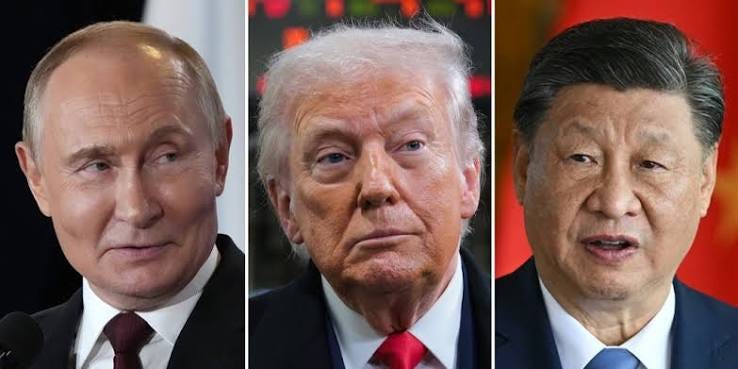
This Thursday, November 19, Donald Trump, Xi Jinping, and Vladimir Putin will meet in Shenzhen on the sidelines of the APEC summit. The official agenda centers on the war in Iran and the future of nuclear arsenals following the expiration of the last bilateral arms treaty between Washington and Moscow.
In Western capitals, commentators have compared the event to the 1945 Yalta Conference, where great powers divided the globe into spheres of influence. Yet this historical parallel is flawed, because the United States is no longer the undisputed titan of the international system.
In 1945, Washington arrived at Yalta dictating terms from unmatched industrial and military supremacy. Backed by half of the world’s manufacturing output, the newly minted Bretton Woods financial system, and unchallenged command of the seas, the United States wrote the rules of the post-war international order and built the institutions designed to enforce them.
This week in Shenzhen, on the other hand, an American president looking for an exit ramp from a disastrous war is flying to Chinese soil to engage his two fiercest strategic rivals, precisely because that 1945 era is over.
The question, however, is how the world’s sole superpower lost its hegemonic influence. How did Russia, once degraded to a fractured, fourth-level power, and China, an agrarian, low-wage economy on the periphery of global trade, become equal to the United States on almost every strategic level?
To answer that, one must look at three interrelated realities, beginning with more than two decades of continuous military and political conflicts.
For over twenty years, the United States plunged into relentless foreign interventions that systematically drained its military and financial capabilities. By pouring trillions of dollars into protracted occupations in Iraq and Afghanistan and engineering bloody, disastrous regime-change campaigns in Libya and Syria, Washington eroded both its domestic economic foundation and the military deterrence that once allowed it to dictate terms to the global community.
At the same time, China and Russia leveraged that twenty-year window to rebuild their economic and military structures. China, for example, capitalized on its 2001 entry into the World Trade Organization to become the indispensable manufacturing hub of the global economy, while Russia consolidated its energy revenues and reasserted its military footprint across Eurasia.
However, as devastating as the physical and financial overreach was, nothing had a greater impact on American hegemony than the blatant double standards exposed by the wars in Ukraine and Gaza.
While Washington demanded absolute adherence to international law when it came to confronting Russia, it simultaneously provided total, unvarnished protection for Israel’s brutal campaign of destruction and what many perceived as genocide in Gaza. That glaring hypocrisy signaled to the entire international community that the American rules-based order was dictated more by geography and ethnicity than actual moral principles.
That loss of credibility produced immediate diplomatic and financial consequences across the world, particularly in the Global South. Rather than lining up behind Western sanctions on Moscow or isolating Tehran, for example, major regional powers expanded the BRICS bloc, settled trade in their own currencies, and built independent payment networks to shield themselves from Washington’s economic pressures. As a result, these nations stripped the United States of the diplomatic consensus and financial leverage it had relied on for decades.
For the United States, it was this combination of more than two decades of war and the total loss of moral hegemony that set the stage for the third and final reality: a confrontation with Iran.
If the conflicts in Ukraine and Gaza stripped away whatever moral authority America had left, its remaining military and economic leverage was wiped out by Iran in the Persian Gulf. Through an asymmetric strategy, Iran trapped the United States in a military and financial bleeding ground where a degraded superpower could be checkmated without Iran ever having to match conventional firepower.
In the opening weeks of the conflict, for instance, Iranian saturation strikes blinded America’s regional detection grid by knocking out early-warning radars, airborne surveillance planes, and THAAD batteries across the Gulf.
Beyond that kinetic destruction, Tehran also drained Washington’s remaining stockpiles and economic tolerance through relentless financial attrition. By forcing American naval forces to fire finite SM-2 and SM-6 interceptor missiles, costing between $2 million and $4 million apiece, to shoot down $20,000 Shahed drones, for example, Iran exhausted both American arsenals and financial capacity at a fraction of the cost. At the same time, by choking off global energy transit through the Strait of Hormuz and Bab el-Mandeb, Tehran paralyzed Western markets and drove up inflationary pressure across the globe.
For Washington, stripped of military deterrence and financial leverage, the arrival at the Shenzhen trilateral summit is not one of unchallengeable dominance but overextension. Desperate for an exit ramp from a conflict it can no longer sustain, Washington is now forced to negotiate a multipolar settlement with the very capitals it spent decades trying to isolate.
Ultimately, whether Washington stumbles into further war or signs on to a managed exit, the era in which the United States could unilaterally dictate the rules of the international system is finished. More fundamentally, the Shenzhen summit illustrates the beginning of the new Asiatic-led global order that will challenge centuries of Eurocentric, Western dominance.
Great breakdown. Beyond the strategic missteps U.S overconfidence made them blind to the global resentment caused by their double standards. You can’t selectively ignore international law for decades and expect the rest of the world to keep backing your leadership. For millions around the world, the Gaza genocide was the ultimate wake-up call.
Credit is actually due for Chinese thinkers and planners also. To reach the place they are today required years of foresight and planning, which they have carried out with perfection. Decades back they understood that globalization of economy will entail supply chain dependencies. Within this chain, they worked out critical points which could be leveraged and today they are leveraging them effectively. Denial of tech by US and its allies to China made it work harder to get the tech and reach where it has reached today. Asiatic Order is certainly arriving as last year Asia accounted for almost 50% of global GDP, closing to its erstwhile 60% of it. India though needs to also plan and execute if it wants to be included rightfully in this emerging Asiatic Order.