

The United States has long been the undisputed master of the skies, a belief backed by a trillion-dollar investment in aviation technology. In the Middle East, this air superiority is the cornerstone of a strategy designed to ensure total victory.
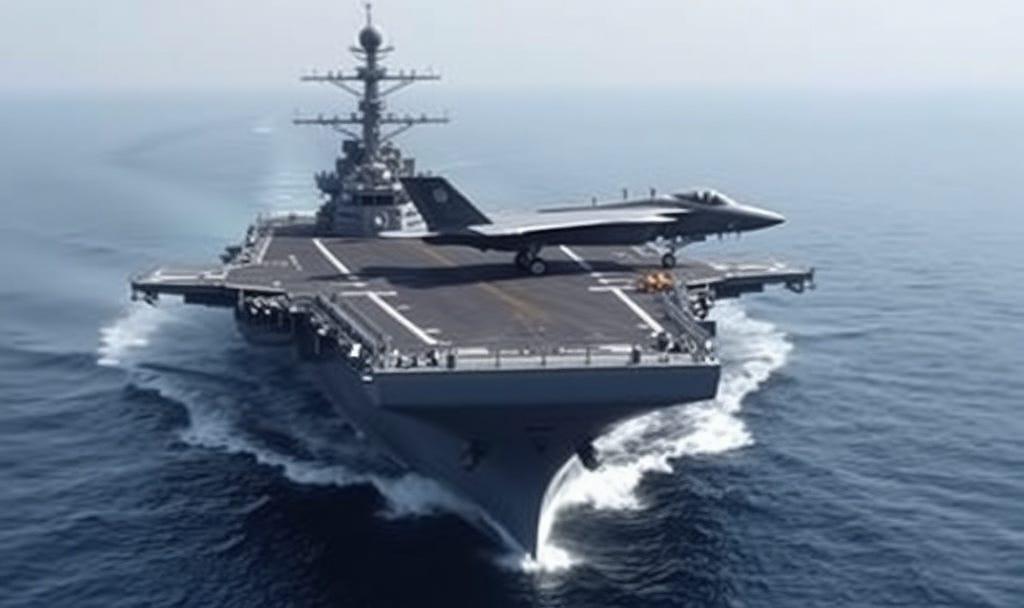
The centerpiece of this power sits the USS Abraham Lincoln, a primary mobile base carrying 5,600 personnel, and an elite wing of F-35 stealth jets and F/A-18E Super Hornets. Combined with B-52 bombers, F-15E Strike Eagles, and a network of 40,000-plus troops distributed across the region, including the UAE, Qatar, and Jordan, the American presence appears geographically and technologically overwhelming.
However, Iran has been preparing for this overwhelming force by turning America’s massive strength into a liability through a sophisticated “Triple Support” strategy.
First, Iran has insulated its command-and-control system using encrypted non-Western technology. By operating on a distinct “digital language,” their system remains immune to U.S. hacking and jamming attempts.
Second, they have integrated the Russian S-400 Triumf, one of the world’s most advanced mobile surface-to-air missile systems, with advanced Russian SU-35 fighters. The combination has created a “no-go” zone, where even U.S. stealth aircraft must weigh the risk of being tracked before reaching a target.
Third, there is Iran’s “Subterranean Mammoth” known as the Oghab 44. Buried 1,000 to 1,600 feet deep inside solid mountain rock, these facilities are designed to withstand almost any conventional attack. They operate on a “shoot and scoot” strategy where mobile launchers fire and vanish before they can be targeted.
To counter these mountain fortresses, the U.S. relies on a “persistent strike’ model using B-52 bombers carrying 70,000-pound bomb loads to continuously target the mountainous areas in the hope of collapsing the tunnel entrance.
But this strategy of high-tech and subterranean resilience has created a paradox: while the U.S. possesses the superior weapon, Iran owns the “superior clock.” Because of its massive radar profile, the B-52 is detected by the Iranian system hundreds of miles away. This gives the Iranian “shoot and scoot” team ample time to fire their missiles and retreat to the safety of the rock.
Because Iran owns the “clock,” the U.S. is forced to keep a constant and expensive presence just to maintain pressure.
The American presence isn’t a single, solid force but a fragmented “spiderweb” spread across nineteen different strategic areas, where no single base is self-sufficient.
Qatar serves as the operational nerve center, Jordan acts as the tactical hub, and Kuwait functions as a large regional warehouse. This system has created a dangerous chain reaction: strikes on the supply depots in Kuwait cause the strike wings in Jordan to run out of ammunition within days. This forced interdependence, initially seen as efficient, means that the “spiderweb” is only as strong as its weakest link.
The ultimate problem for this chain reaction is the USS Abraham Lincoln. While the aircraft carrier is a mobile fortress, its greatest strength is also its greatest weakness: its flight deck. A single successful attack on the flight deck would make the entire multi-billion-dollar ship ineffective. Without a functioning deck, not only would the elite F-35s have nowhere to land, but none of the planes could be launched. In an instant, rendering the world’s most advanced jets useless.
There is also America’s massive dependency on vulnerable ports. Despite their perceived mobility, carrier strike groups are ‘chained” to specific deep-water stations like Jebel Ali in the UAE or Hamad Port in Qatar to replenish magazines and fuel. If Iran successfully targeted these piers, it would trigger a total system failure. Without a functional port, a billion-dollar destroyer effectively becomes a “floating battery” with a limited shelf life, unable to take on the massive amounts of supplies needed for a high-intensity conflict.
Finally, America operates on a 21-day supply cycle and relies heavily on the global supply chain. Since the U.S. does not always use its own ships for transporting all goods, particularly non-combat items such as medical supplies and food, it often relies on third-party shipping. Generally, the Chinese state-owned company COSCO is the primary provider of these goods. Given Iran’s relationship with China, this supply chain can easily be severed.
Ultimately, the strategy of Iran’s air defense system is similar to its naval one: an asymmetric war of attrition where the U.S. would deplete its resources by fighting a war it cannot afford.
But if the ‘Spiderweb’ is this fragile, what is the final move? We will address that in the final part of the series in two days.
·