

To counter what it perceives as regional threats, the United States has deployed a massive concentration of power to the Persian Gulf: a $50 billion “Armada” centered around the USS Abraham Lincoln and the USS Theodore Roosevelt.
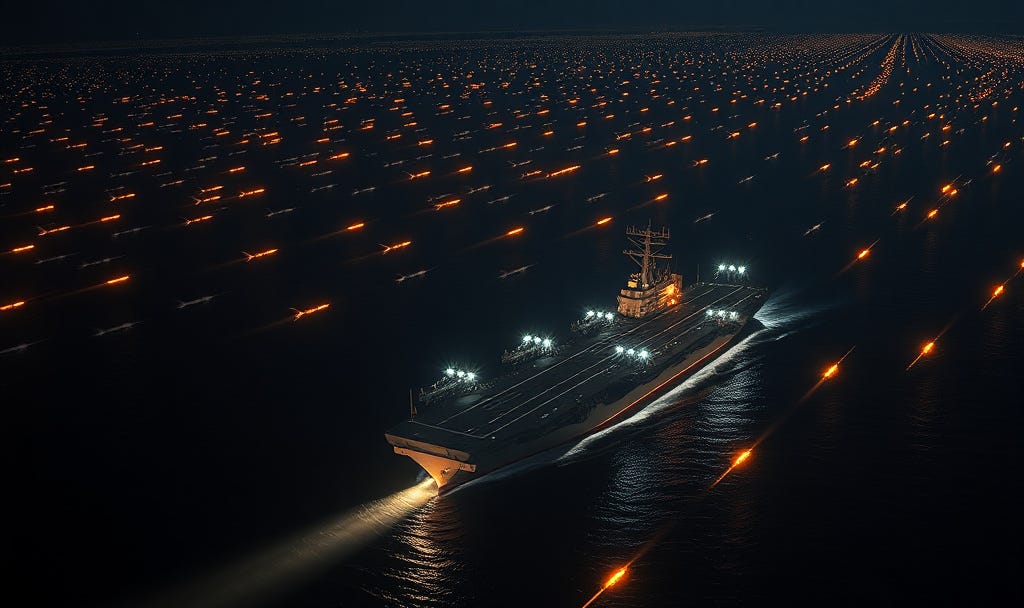
While these floating cities are the marvels of 20th-century engineering, in the 35-mile-wide “green water” strait of the Gulf, they are increasingly becoming the 21st-century “bathtub”. In the vast, open blue waters of the ocean, these carriers are apex predators. But in the narrow confines of the Gulf, these massive ships become a major liability.
The primary threat to the Armada is a matter of industrial math. US destroyers, like the Arleigh Burke-class, rely on Vertical Launch System (VLS) cells that hold approximately 96 missiles. These so-called “Golden missiles” are expensive, rare, and impossible to reload at sea.
Iran’s “Swarm Doctrine” aims to exploit this strategic weakness by launching thousands of cheap drones and missiles simultaneously. This approach forces the Navy to expand its munitions in Kinetic Exhaustion as it utilizes its limited supplies of high-end munitions until they are exhausted. For example, a standard Carrier Strike Group (CSG) typically carries 380 to 450 interceptors across its escorts.
In a high-intensity saturation strike involving hundreds of incoming targets, a destroyer can empty its VLS tubes in under an hour. Because these cells cannot be reloaded at sea, the ship must retreat to a specialized port. This reload cycle can take up to 21 days because each 3,000-pound missile canister must be vertically hoisted with perfect precision into a tiny opening on the Ship’s deck. This is a delicate, time-consuming process that requires specialized cranes, calm waters, and heavy port infrastructure. In a prolonged conflict, the Armada would undergo a continuous cycle of withdrawal, with escort ships leaving one by one every two or three weeks, ultimately leaving the carriers vulnerable.
Thus, if Iran launches just 15% of its stockpile, the US destroyers mathematically run out of “breath” (missile cells) before the primary strike even arrives.
The true deadliness of the ‘mathematical trap’ doesn’t stop at the waterline. While the Armada scans the sky, a silent, invisible threat waits beneath the waves. The US Navy has bet its future on high-tech, autonomous machines like the Orca (XLUUV), a massive, 80-ton unmanned submarine that can travel 6500 miles and remain submerged for months. Equipped with Synthetic Aperture Sonar, this marvel of technology allows it to map the floors of both the Atlantic and Pacific oceans.
There is also the REMUS 600, a small man-portable drone that can be launched with two or three men from the side of the ship. Packed with high-resolution sensors, the REMUS sensors can create a 3D resolution of the sea floor and find objects that are invisible to ship-based sensors.
However, even the most marvelous piece of technology can be blindsided in the deep, murky waters of the Persian Gulf. The Iranians have designed “Underwater Ghosts” like the Ghadir-Class midget submarines that lie silently on the rocky seafloor. Because the Orca relies on acoustic signatures, it often cannot distinguish a Ghadir from seafloor debris. Furthermore, because Ghadir is manned, its crew can stay powered down and invisible; therefore, they can activate when the other sensors have passed by.
Iran also operates several underwater drones and unmanned submarines, including Fateh and Nahang, each with distinct roles. The 49-meter Fateh coordinates submerged operations and carries Jask-2 cruise missiles, which are launched from a torpedo shell that swims away before surfacing to strike, allowing Fateh to remain undetected.
The 25-meter Nahang prototype, on the other hand, specializes in deploying silent Smart Mines in shallow Gulf waters; its small, sonar-evading design makes it hard for US systems like the Orca or Remus 600 to detect until after an attack has occurred.
The ultimate predator, however, is Hoot. Traveling at 200+ knots, this via supercavitating torpedo gives a carrier crew less than 90 seconds to react. By targeting unarmored propellers and rudders, the HOOT can leave a $13 billion carrier drifting helplessly in a single afternoon.
Despite the challenges beneath the waves, the US Navy pivots to its above-water masterpiece: Directed Energy Weapons, commonly known as lasers. Systems like ODIN (Optical Dazzling Interdictor, Navy) and HELIOS (High Energy Laser with Integrated Optical-dazzler and Surveillance) use the speed of light to burn through their targets, preventing hundreds of cheap drones from hitting the ship’s deck.
However, even these high-tech systems often face a significant “glitch in the Persian Gulf environment. The humid, salty, and dusty air causes the laser beam to scatter, stripping it of the power needed to stop a mass drone swarm effectively. Furthermore, these weapons require massive continuous power and are limited in number, with only a few ships in the region equipped with them.
The greatest threat to the American Armada, however, isn’t the drones or torpedoes; it is the Iranian mindset. They view the defense of their land as the ultimate form of sacrifice, honor, and obligation. To them, the Persian Gulf is their home, and the Iranian navy is committed to protecting it regardless of the cost. They believe that even if they were to lose 90% of their navy, crippling the US Carrier Strike Group, it would be worth the price.
In the next chapter, we move from the subsurface to the sky to explore the US’s airpower and Iran’s aerial air strategy. We will see whether the US’s F-35 and B-52 can handle the swarms of Shahed and Mohajer drones.
Coming tomorrow: Part 2- The drone Wall and the Stealth Dilemma.