

As American transport aircraft continued to land at bases such as Prince Sultan Air Base (PSAB) in Saudi Arabia, offloading what appeared to be advanced defensive batteries and heavy munitions, many observers view this as an indication that the American military is preparing for a wider regional conflict.
For some, however, the surface-level activity represented a deeper, contrary operation. That is, even with those heavy arrivals, the deployment was, in fact, a tactical deception. This was less a preparation for a longer war and more of a frantic American effort to sustain a position in a country that had effectively revoked the invitation. A desperate attempt to secure the logistics necessary for a quiet extraction.
To understand, however, whether the U.S. is truly preparing for a wider war or a safe, successful exit, one must first look at the foundational structure of the Saudi state and the collapse of an ancient contract between the King and his people.
For nearly a century, the Saudi Kingdom was anchored on a sacred 1932 Covenant, which tied the House of Saud, the tribes, and the religious establishment into a single, cohesive power structure. It was a pact of mutual reliance where the King provided protection and respect for the desert’s traditions, and in return, the tribes and the clergy, the stewards of the nation’s soul and land, provided the mandate to rule. That balance of power, however, was shattered when the American-led war on Iran triggered a rapid, asymmetric Iranian response.
By successfully striking the American bases and subsequently closing the Strait of Hormuz, the Iranians exposed the Kingdom’s fatal flaw: Crown Prince Mohammad Bin Salman (MBS) could no longer guarantee the two pillars, economic stability and military security, that had defined the covenant for almost a century. Thereby, rendering the pact between the King and his people obsolete.
With the covenant dead, the two primary tenants of the nation, the tribes and the clergy, responded by reclaiming their authority. In the case of the tribes, MBS’s authority began to be rejected throughout the kingdom. In the North, for example, the Shammar and the Howeitat tribes exerted their power by physically halting all commercial movements between Saudi Arabia and its neighbors, Jordan and Iraq, while in the West, the Harb tribe made a similar stance.
For the tribes, however, the logistical chokehold was not merely directed towards MBS but also against his American backers. By severing the land routes and preventing the flow of all goods through their territory, the tribes stripped away the American military protection, which left them even more vulnerable to Iranian attacks.
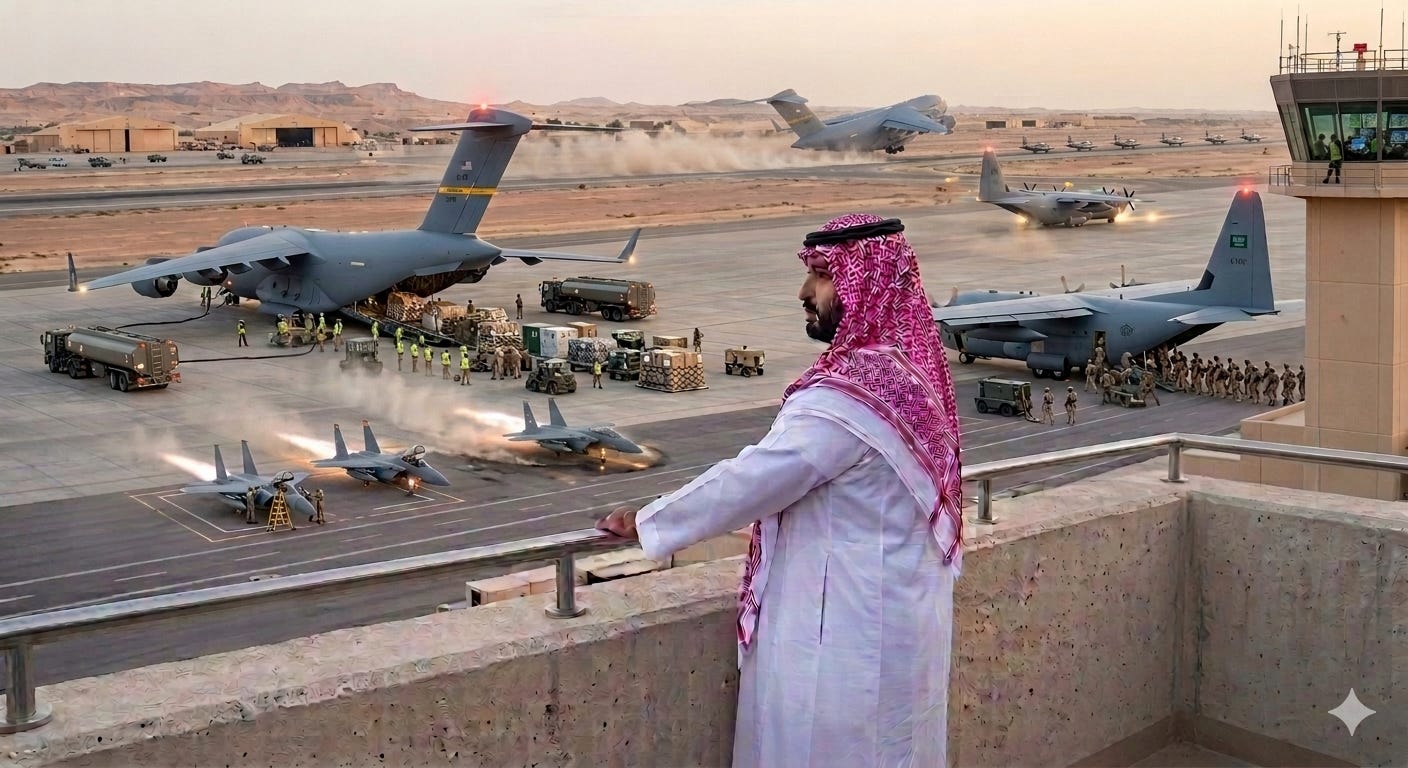
For the first time, the U.S. found itself in an expensive and precarious “air bridge” situation where everything from food and water to artillery components had to be flown in because the tribes no longer provided the permission needed to operate via the land.
The tribal leverage extended immediately to the national grid, turning water and electricity into explicit political instruments. In the West, the Harb tribe exerted its influence over desalination plants and power output centers near Jeddah. By throttling the output, they ensured that the city suffered from intermittent water access and constant rolling blackouts that the government could no longer control. In the center, near Riyadh, local tribal coalitions exerted similar pressure, throttling the power stations that fed the capital’s core infrastructure.
For the United States, this internal conflict between MBS and the tribes created an immediate and unsustainable crisis. As was the case with the logistic blockade, the problem did not end merely at the tribal door. It extended to America’s ability to sustain its war.
That is, the United States may have had its own internal generators and secondary water reserves, but it remained fundamentally tethered to the national supply chain. A supply chain that, if disrupted during military operations, could result in massive human and military losses.
Today, the U.S. finds itself in a situation where it is totally dependent on a land whose tribes control the very energy, water, and infrastructure it requires to endure a war against Iran. This logistical deficit, compounded by the strategic reality of depleted missile stockpiles, is an absolute fact that cannot be overcome. When the math of supply chains and interceptor inventories no longer supports a prolonged conflict, the arrival of heavy equipment ceases to be the precursor for a wider war. Instead, it becomes a necessary cover for a controlled retreat.
In other words, the equipment, the fuel, the water, and the defensive batteries may not be intended to expand the battlefield. Rather, it may well be the logistical cushion required to manage a safe withdrawal from a site that has already become a siege site.
Nonetheless, this does not indicate that a wider war will not occur. The conflict between Iran and Israel, for example, has not been resolved and will not likely be until a clear victor emerges.
However, the conflict involving the U.S. in Saudi Arabia is fundamentally different. While Washington may look to pivot its strike capabilities to more secure footholds like Kuwait or the UAE, the specific position in Saudi Arabia has become logistically untenable.
Despite Washington’s posture and influx of heavy armaments, the fact remains that the Kingdom is no longer a viable base of operations. Thus, whether Washington chooses to wither on the vine or execute a full, quiet withdrawal, the strategic reality remains the same: the United States has lost its ability to project power from within the Kingdom.
I personally think they’re toast in the gulf, they’re out by hook or by crook, it’s only a matter of time. I read the pentagon estimates 10-12 billion USD to rebuild those bases and about 5-7 years to do so.
Many critics of Israel and its military strategy argue that the continuing conflict with Iran has become increasingly dangerous because of unwavering military backing from the United States. Opponents of American policy claim that billions in weapons, missile systems, intelligence cooperation, and diplomatic protection have allowed Israel to pursue increasingly aggressive regional actions without facing meaningful international pressure to de-escalate.
Opponents point to mounting civilian casualties, regional instability, and the widening risk of a broader Middle East war as evidence that endless military support is not producing peace, but prolonging confrontation. Some analysts have also warned that the scale of U.S. military involvement and missile defence support for Israel has strained American resources and increased fears of a much larger regional conflict.
Opponents of continued U.S. aid argue that Washington’s close alignment with Israel damages America’s credibility when speaking about human rights, international law, or democracy abroad. They believe the conflict increasingly resembles a cycle where overwhelming military force is repeatedly prioritised over diplomacy, ceasefires, or long-term political solutions.
Critics also argue that ordinary Americans are being drawn into costly geopolitical struggles through military spending, economic disruption, and rising instability in global energy markets. At the same time, political leaders continue defending policies that large parts of the international community oppose. Recent polling and political backlash suggest growing unease in several Western countries about deeper involvement in the Iran-Israel confrontation, particularly as fears rise over escalation, regional collapse, and the possibility of wider war.