

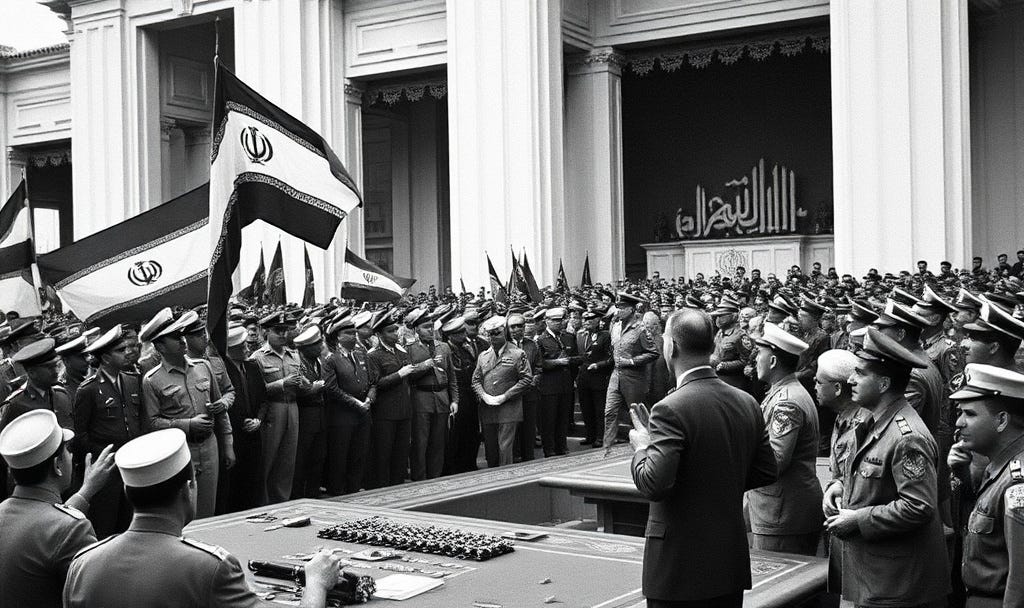
As time has passed, the events of early January 2026 in Iran are being reframed. What traditional Western media initially painted as a spontaneous “Freedom Uprising” is now being recognized by many, particularly in the Global South and among the Iranian population, as a sophisticated, foreign-orchestrated coup attempt.
Though the spark that started the protest was a genuine economic concern, the rapid shift toward high-intensity violence and the “gloat-posting” by Israeli intelligence figures on social media have convinced the Iranian middle class that they were being used as pawns in a pre-planned regime-change operation.
The unrest, widely hailed as the “beginning of the end” for the Islamic Republic, largely fell silent within weeks. This was not merely the result of a telecommunications blackout or police presence but rather a psychological, military, and political strategy that compelled the “Gray Layer,” the silent middle class, return to the state’s embrace.
But how was the Iranian state able to bring the public back into its fold, and why didn’t the protest expand as many of Iran’s adversaries hoped? The answers lie within the psyche and history of the Iranian people.
First, the unprecedented violence of the protests in early January shocked the public conscience. Footage of dozens of mosques being vandalized and burned, a nurse burned alive in a medical clinic, and the targeted killing of more than 100 police and security officers was a redline. In the eyes of the silent majority, these acts transformed the protesters from “liberators” into agents of chaos. This, in turn, gave legitimacy to the government’s accusations that the movement was led by “Zionist-backed” agents intent on destruction.
Second, the Iranian President’s pragmatic and strategic approach to the Grand Bazaar effectively cut the legs out from under the movement. By warning the Bazaaris that a collapse of the state would destroy centuries-old commercial networks, the government secured a strategic truce. The merchants chose the “devil they knew” over an unpredictable revolution and a post-regime vacuum. In exchange for a return to order and the rollout of the Kalaberg digital coupon system, which provided credits for a basket of essential goods at the rate of inflation, the Baazar was allowed the continued use of Gold and Bitcoin as a form of payment. Consequently, the Bazaar withdrew its support for the general strike.
Third, the “Syria Fear” and the memory of the 12-Day War of June 2025 created a nationalist shield for the government. With the scars of the June 2025 airstrikes still fresh, many Iranians feared that a domestic collapse would only invite a second and more devastating round of foreign intervention. The collective memory of that war, carried out by the same nations that were backing the violent protestors, turned the state’s survival into a matter of national survival. This convinced the population that a flawed government was a better defense against “Syrian-fication” than a fragmented opposition.
Fourth, the backlash against boasting turned domestic struggle into a national cause. As the Israeli government and pro-Israeli media channels began boasting about “on-the-ground networks” and the provision of “live weapons” to protest cells, the average Iranian was outraged. Seeing foreign-backed accounts celebrating the destruction of Iran altered the perception of the movement from a “domestic struggle for economic help” into a foreign-led war of aggression.
Fifth, and often overlooked, was the Iranian government’s support from the Global South. Many nations viewed the protest as a “hybrid war” initiated by the West for the benefit of Israel. By January 2026, prominent voices from the Global South were labeling the protestors as “mercenaries” designed to pull the world’s attention away from Israel’s genocide in Gaza. This provided the government with the international support it needed while exposing Western double standards.
Perhaps most decisively, the movement was undermined by the rhetoric of Reza Pahlavi, whose open encouragement of President Trump’s and Netanyahu’s “attack” on Iran handed the government the ultimate propaganda victory.
By aligning himself with the same foreign powers responsible for the 1953 CIA-backed overthrow of democratically elected Mohammad Mossadegh, Pahlavi was successfully branded as a “puppet prince” and a traitor.
When he called for “coordinated attacks” from American soil, during the height of the protest, Pahlavi triggered a national trauma. To the Iranian people, his call for “Western bombs” was not about liberation, but about the betrayal of their sovereignty. To Iranians, he wasn’t seen as a leader but as a “1953 ghost” revived to sell out the nation for a second time.
I have not had time to read all your articles, yet, but I am working my way up from the earliest post to the more recent.
Do you have an article which gives more information about public opinion about the government they dislike, and the percentage of the regime steadfast supporters versus other segments of society ?
"Weary of mismanagement but terrified of Syrian-style collapse, the Iranian public made a cold, nationalistic, calculated decision to stand behind their nation, even if it meant the government they disliked."
Also thank you for introducing me to Iran's Grand Bazaar. I read what Wikipedia posts about the bazaar which gives a little background on its influence in Iran. I found this page, among others, and ask if the image at the top of the page is in fact the Grand Bazaar -- I assume it is, but do you have any comments about the image? Another page made the claim that it is the largest mall in the world?
https://en.ifilmtv.ir/News/Content/37529/
Did it fail ? I guess the loss of Iranian lives means nothing to you as long as you keep bashing Israel as the sole complicit factor